Skip to main content
Physics with Calculus
My Course
Learn
Exam Prep
AI Tutor
Study Guides
Textbook Solutions
Flashcards
Explore
Try the app
My Course
Learn
Exam Prep
AI Tutor
Study Guides
Textbook Solutions
Flashcards
Explore
Try the app
Back
Intro to Energy & Kinetic Energy quiz #4
You can tap to flip the card.
The kinetic energy from an object's motion always changes when which factor changes?
You can tap to flip the card.
👆
The kinetic energy from an object's motion always changes when which factor changes?
Kinetic energy changes when speed changes.
Track progress
Control buttons has been changed to "navigation" mode.
1/33
Related flashcards
Related practice
Recommended videos
Intro to Energy & Kinetic Energy definitions
Intro to Energy & Kinetic Energy
15 Terms
Intro to Energy & Kinetic Energy quiz #1
Intro to Energy & Kinetic Energy
36 Terms
Intro to Energy & Kinetic Energy quiz #2
Intro to Energy & Kinetic Energy
40 Terms
Intro to Energy & Kinetic Energy
9. Work & Energy
7 problems
Topic
Patrick
Intro to Calculating Work
9. Work & Energy
6 problems
Topic
Patrick
9. Work & Energy - Part 1 of 2
3 topics
8 problems
Chapter
Patrick
9. Work & Energy - Part 2 of 2
5 topics
12 problems
Chapter
David-Paige
Guided course
04:10
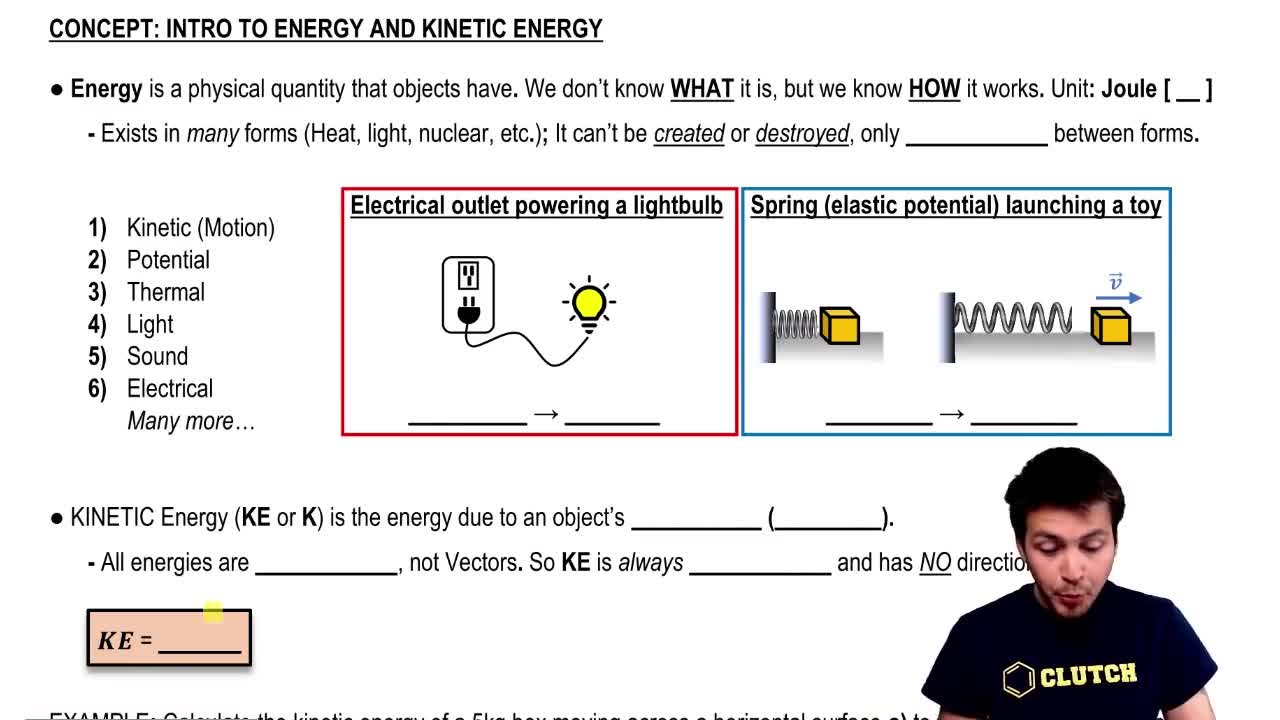
Intro to Energy & Types of Energy
22852
views
557
rank
Terms in this set (33)
Hide definitions
The kinetic energy from an object's motion always changes when which factor changes?
Kinetic energy changes when speed changes.
What two forms of energy are associated with mechanical energy?
Kinetic energy and potential energy.
If 320 joules of work are done by a force of 80 newtons, over what distance was the force applied?
Distance = Work / Force = 320 J / 80 N = 4 meters.
How do machines multiply force without multiplying work?
Machines trade force for distance; they increase force by decreasing the distance over which it is applied, keeping work constant.
How far up a hill will a car coast before rolling back down, in terms of energy?
A car will coast up the hill until its kinetic energy is fully converted into potential energy.
If a 16 N force is applied to an object and 96 J of work is done, how far was the object moved?
Distance = Work / Force = 96 J / 16 N = 6 meters.
Is work done if you pull a child in a wagon?
Yes, work is done when you pull a child in a wagon.
When is kinetic energy transferred from one object to another?
Kinetic energy is transferred during collisions or interactions between objects.
Why is energy required to get an object moving?
Energy is required to overcome inertia and provide the object with kinetic energy.
What is true about a car moving at constant velocity?
A car moving at constant velocity has constant kinetic energy.
What is the unit of measurement for work?
The unit of work is the joule (J).
What is the energy transformation in an electric motor?
An electric motor converts electrical energy into mechanical energy.
How is work defined in physics?
Work is defined as the transfer of energy by a force acting over a distance.
If the total energy of a block-spring system is doubled, what happens to the amplitude?
If total energy is doubled, amplitude increases by a factor of √2.
What is the potential energy of a spring with stiffness 100 N/m compressed by 0.1 m?
Potential energy = 0.5 × 100 N/m × (0.1 m)^2 = 0.5 joules.
What is the relationship between work and energy?
Work is the process of transferring energy to or from an object.
What is an example of work being done on an object?
Lifting a box off the ground is an example of work being done.
What is an example of potential energy?
A stretched rubber band has potential energy.
What is the relationship between kinetic energy and potential energy?
Kinetic and potential energy can transform into each other, but their sum is conserved in a closed system.
What energy transformation occurs when a skydiver first jumps from a plane?
Potential energy is converted into kinetic energy.
How much work does a battery connected to a 21.0-ohm resistor perform in one minute?
Work done = Power × time; Power depends on voltage and resistance (not provided), so use W = P × t.
What is the car's speed after coasting down the other side of a hill, in terms of energy?
The car's speed is determined by the conversion of potential energy back into kinetic energy.
What is the speed of an object at half its maximum height during vertical motion?
At half maximum height, use energy conservation: KE = total energy - PE; solve for speed using KE = 0.5mv^2.
What happens in terms of energy when a moving car hits a parked car?
Kinetic energy is transferred from the moving car to the parked car, possibly causing both to move.
How do potential and kinetic energy compare?
Potential energy is stored due to position; kinetic energy is due to motion. Both can transform into each other.
What energy transformation occurs in an electric pencil sharpener?
Electrical energy is converted into mechanical energy.
What does the mechanical energy of a system include?
Mechanical energy includes both kinetic and potential energy.
How far will you travel in 3 minutes running at a rate of 6 m/s?
Distance = speed × time = 6 m/s × 180 s = 1080 meters.
As an object in motion becomes heavier, what happens to its kinetic energy?
Its kinetic energy increases.
If a speeding truck hits a wall, what type of energy is in the motion of the truck?
The truck's motion is kinetic energy.
What does total stopping time consist of?
Total stopping time consists of reaction time and braking time.
Why is making rough estimates of physical quantities useful?
Making rough estimates helps check the reasonableness of answers and understand physical situations.
How do you find the kinetic energy of a car at the top of a loop?
Use KE = 0.5 × mass × (speed at top)^2.
 BackBack

 04:10
04:10