Kinematics Equations quiz #1 Flashcards

Kinematics Equations quiz #1
Control buttons has been changed to "navigation" mode.
1/10
  • What happens to the stopping distance of a vehicle when its speed doubles, assuming constant deceleration?
    When the speed of a vehicle doubles, its stopping distance increases by a factor of four, because stopping distance is proportional to the square of the initial speed (d ∝ v₀² for constant acceleration).
  • How can you determine during which time interval an object travels approximately 10 meters using kinematics equations?
    To determine the time interval during which an object travels approximately 10 meters, use the appropriate kinematics equation based on known variables (such as initial velocity, acceleration, and time), and solve for the time when the displacement (Δx) equals 10 meters.
  • Which physical quantities do kinematic equations relate in problems involving constant acceleration?
    Kinematic equations describe the relationship between displacement (Δx), initial velocity (v₀), final velocity (v), acceleration (a), and time (t) for motion under constant acceleration.
  • What is the general formula for the stopping distance of a vehicle under constant acceleration?
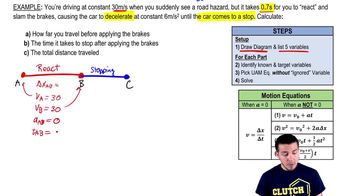
    The general formula for stopping distance under constant acceleration is: d = v₀² / (2|a|), where v₀ is the initial speed and a is the (negative) acceleration.
  • If a ball starts from rest and accelerates at a constant rate, which kinematic equation can be used to find its displacement after a given time?
    If a ball starts from rest (v₀ = 0) and accelerates at a constant rate, use Δx = (1/2) a t² to find its displacement after time t.
  • How can you determine the maximum speed a particle could have at x = 2.0 m and never reach x = 6.0 m, using kinematics principles?
    To determine the maximum speed at x = 2.0 m such that the particle never reaches x = 6.0 m, set the final velocity to zero at x = 6.0 m and use the kinematic equation v² = v₀² + 2aΔx, solving for the initial velocity at x = 2.0 m with Δx = 4.0 m and a < 0.
  • If two cars start from rest and accelerate at different rates, how can you determine which car has traveled farther after 10 seconds?
    To determine which car has traveled farther after 10 seconds, use the kinematic equation Δx = v₀ t + (1/2) a t² for each car (with v₀ = 0), and compare the resulting displacements based on their accelerations.
  • What is a valid way to construct a motion diagram for an object under constant acceleration?
    A valid way to construct a motion diagram is to represent the object's position at equal time intervals, showing velocity vectors that change in length according to the acceleration, with increasing or decreasing spacing between positions.
  • Approximately how far can a car traveling at 55 mph stop under ideal conditions, according to kinematics principles?
    A car traveling at 55 mph can stop in approximately 90 to 100 feet under ideal conditions, based on typical deceleration rates and the stopping distance formula d = v₀² / (2|a|).
  • What is the approximate stopping distance for a car traveling at 50 mph under ideal driving conditions?
    The stopping distance for a car traveling at 50 mph under ideal conditions is approximately 80 to 90 feet, as calculated using the kinematic stopping distance formula.