Which sample of particles has the lowest average kinetic energy?
The sample with the lowest temperature has the lowest average kinetic energy, since average kinetic energy depends only on temperature.
How can you determine which of several samples has the lowest average kinetic energy?
Compare the temperatures of the samples; the one with the lowest temperature has the lowest average kinetic energy.
What physical quantity measures the average kinetic energy of a system of particles?
Temperature measures the average kinetic energy of the particles in a system.
How is the average kinetic energy of an object (or particle in a gas) calculated?
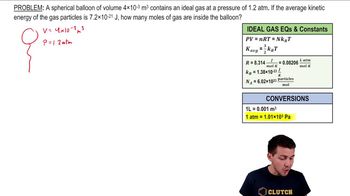
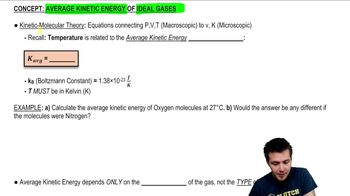
The average kinetic energy per particle in an ideal gas is given by K = (3/2) kB T, where kB is the Boltzmann constant and T is the temperature in Kelvin.
How is the average kinetic energy of the particles in a sample of matter expressed?
The average kinetic energy of the particles is expressed as K = (3/2) kB T, with T in Kelvin.
If the average kinetic energy of gas atoms is tripled, by what factor does the temperature change?
Since average kinetic energy is directly proportional to temperature (K ∝ T), tripling the average kinetic energy means the temperature is also tripled.
What must you do to a temperature given in Celsius before using it in the average kinetic energy formula for gases?
You must convert the temperature from Celsius to Kelvin by adding 273 to the Celsius value. This ensures the calculation yields a physically meaningful, non-negative energy.
Why does the average kinetic energy formula for an ideal gas not include the mass or type of gas?
The formula K = (3/2) kB T only involves the Boltzmann constant and temperature, not the mass or identity of the gas. This means all ideal gases at the same temperature have the same average kinetic energy per particle.
What is the significance of the Boltzmann constant in the average kinetic energy equation?
The Boltzmann constant (kB) acts as a proportionality factor linking temperature to energy at the particle level. It allows temperature in Kelvin to be directly related to the average kinetic energy per particle.
If some molecules in a gas have more energy and some have less, what does the calculated average kinetic energy represent?
The calculated average kinetic energy represents the mean energy per particle when averaging over all the molecules in the sample. It does not describe the energy of any single molecule but the statistical average for the group.