Mass Distribution with Calculus quiz #1 Flashcards
Mass Distribution with Calculus quiz #1
You can tap to flip the card.
Control buttons has been changed to "navigation" mode.
1/10
Terms in this set (10)
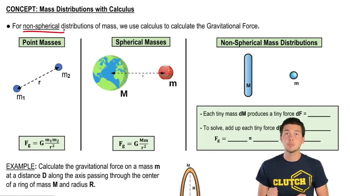
How is mass defined in the context of gravitational force calculations for non-spherical objects?
Mass is the amount of matter in an object and, for non-spherical objects, is considered by breaking the object into differential mass elements (DM) and integrating over the entire distribution to find the total mass.
How are mass and weight related in the context of gravitational physics?
Weight is the gravitational force exerted on an object and is equal to the object's mass multiplied by the acceleration due to gravity (W = mg).
What is the key point to remember about the relationship between mass and weight?
Mass is an intrinsic property of an object and does not change with location, while weight depends on the local gravitational field and can vary depending on where the object is.
How do you determine the mass of an object when calculating gravitational force using calculus for a non-spherical mass distribution?
To determine the mass, you integrate the differential mass elements (DM) over the entire object, so the total mass M is the integral of DM.
What is a measurement of an object's mass in the context of gravitational force calculations?
An object's mass is measured in kilograms (kg) and represents the total amount of matter, which is used in gravitational force equations.
Which physical quantities involved in gravitational force calculations are affected by mass?
The gravitational force between two objects is directly proportional to the product of their masses.
Why does a golf ball have more mass than a tennis ball, in terms of gravitational force calculations?
A golf ball has more mass than a tennis ball because it contains more matter, which increases the gravitational force it can exert or experience.
If a player has more mass, what other property related to gravitational force will also increase?
If a player has more mass, their weight (the gravitational force acting on them) will also increase.
Which property of your vehicle affects its inertia in the context of mass distribution and gravitational force?
The mass of your vehicle affects its inertia; greater mass means greater resistance to changes in motion.
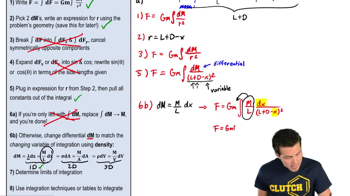
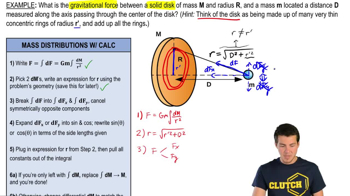
Why do the y-components of the differential gravitational forces cancel out when calculating the net force from a symmetric ring on a point mass?
The y-components cancel because for every differential mass element on the ring, there is a symmetrically opposite element whose y-component of force is equal in magnitude but opposite in direction. This symmetry ensures that only the x-components add up to produce the net force.