What is the best description of Earth's orbit around the Sun according to Kepler's laws?
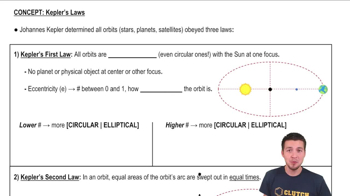
Earth's orbit around the Sun is an ellipse, with the Sun located at one of the foci of the ellipse.
What causes the apparent retrograde motion of the planets as observed from Earth?
Apparent retrograde motion occurs because Earth and other planets travel at different speeds in their elliptical orbits, causing planets to appear to move backward in the sky relative to the stars when Earth overtakes them.
According to Kepler's laws, how do planets move in their orbits?
According to Kepler's laws, planets move in elliptical orbits with the Sun at one focus, sweep out equal areas in equal times, and have orbital periods related to their average distance from the Sun by the relationship T^2 β R^3.
Which phenomenon is explained by Kepler's laws of planetary motion?
Kepler's laws explain the elliptical shape of planetary orbits, the variation in orbital speed, and the relationship between orbital period and distance from the Sun.
What is the difference between Earth's perihelion and its aphelion?
Earth's perihelion is the point in its orbit closest to the Sun, while aphelion is the point farthest from the Sun.
Which orbital effect describes how the shape of Earth's orbit around the Sun can change over time?
The shape of Earth's orbit is described by its eccentricity, which can change over time, making the orbit more or less elliptical.
What motion of Earth is responsible for the occurrence of seasons?
The tilt of Earth's axis relative to its orbital plane and its revolution around the Sun are responsible for the seasons.
What does Earth's axial tilt cause in terms of its annual cycle?
Earth's axial tilt causes the variation in sunlight received at different latitudes throughout the year, resulting in the seasons.
Which of Kepler's laws of planetary motion is a consequence of the conservation of angular momentum?
Kepler's Second Law, which states that a planet sweeps out equal areas in equal times, is a consequence of the conservation of angular momentum.
Where must the Moon be in its orbit for the full moon phase to be visible from Earth?
The full moon phase occurs when the Moon is on the opposite side of Earth from the Sun, so that the entire face of the Moon visible from Earth is illuminated.
What does Kepler's Second Law indirectly describe about planetary motion?
Kepler's Second Law indirectly describes that a planet moves faster when it is closer to the Sun and slower when it is farther away.
How does a planet move when following an elliptical orbit around the Sun according to Kepler's laws?
A planet in an elliptical orbit moves faster when it is closer to the Sun and slower when it is farther away, sweeping out equal areas in equal times.
Who discovered the three laws of planetary motion?
Johannes Kepler discovered the three laws of planetary motion.
In terms of orbit, what is the significance of eccentricity?
Eccentricity measures how much an orbit deviates from being circular; an eccentricity of 0 is a perfect circle, while values closer to 1 indicate more elongated ellipses.
What are three major contributions Johannes Kepler made to astronomy?
Johannes Kepler contributed: 1) the discovery that planetary orbits are ellipses with the Sun at one focus, 2) the law that planets sweep out equal areas in equal times, and 3) the relationship between orbital period and distance from the Sun (T^2 β R^3).
Earth is closer to the Sun in January than in July. According to Kepler's Second Law, how does Earth's speed in its orbit compare between these times?
According to Kepler's Second Law, Earth moves faster in its orbit when it is closer to the Sun (in January) and slower when it is farther away (in July).
What did Newton show about Kepler's laws?
Newton showed that Kepler's laws are a consequence of the law of universal gravitation.
According to Kepler's Third Law (T^2 β R^3), how does a planet's mass affect its orbit around the Sun?
According to Kepler's Third Law, a planet's mass does not affect its orbit around the Sun; the law depends only on the mass of the Sun.