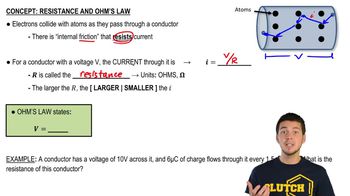
Ohm's law describes the relationship between which three quantities in an electric circuit?
Ohm's law describes the relationship between voltage (V), current (I), and resistance (R).
What is the SI unit for electrical resistance?
The SI unit for resistance is the ohm, symbolized by the Greek letter omega (Ω).
What effect does conductor resistance have between a voltage source and a connected load?
Conductor resistance causes a voltage drop between the voltage source and the connected load.
What does Ohm's law state about the relationship between voltage, current, and resistance?
Ohm's law states that the voltage across a conductor is equal to the product of the current through it and its resistance: V = IR.
What is the formula from Ohm's law for finding the current in a circuit?
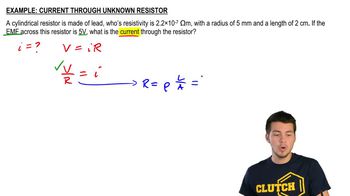
The formula for current using Ohm's law is I = V / R.
What is one function of a resistor in an electric circuit?
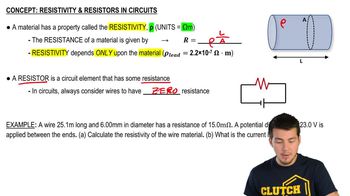
A resistor limits or controls the amount of current flowing in a circuit.
How can you determine the resistance of a resistor using Ohm's law if you know the voltage across it and the current through it?
The resistance can be found using R = V / I.
What is the relationship between current and voltage across a circuit according to Ohm's law?
According to Ohm's law, current is directly proportional to voltage and inversely proportional to resistance: I = V / R.
State Ohm's law in terms of voltage, current, and resistance.
Ohm's law states that V = IR, where V is voltage, I is current, and R is resistance.
Which formula represents Ohm's law?
Ohm's law is represented by the formula V = IR.
Which equation expresses Ohm's law?
Ohm's law is expressed as V = IR.
How does resistance in a circuit affect current flow?
Resistance in a circuit opposes or reduces current flow.
Which formula is not an expression of Ohm's law: V = IR, I = V/R, R = V/I, or P = IV?
P = IV is not an expression of Ohm's law; it is the formula for electric power.
How is the resistance of a resistor determined using color bands?
The resistance of a resistor can be determined by interpreting the color bands according to a standard color code chart.
Which equation is correct according to Ohm's law?
According to Ohm's law, V = IR is the correct equation.
How can you verify that a circuit obeys Ohm's law?
A circuit obeys Ohm's law if the ratio of voltage to current remains constant, indicating a linear relationship: V = IR.
Which physical quantities are related by Ohm's law?
Ohm's law relates voltage, current, and resistance.
According to Ohm's law, how does increasing resistance affect current if voltage is kept constant?
According to Ohm's law, increasing resistance decreases the current if voltage is kept constant.
How do you calculate the effective resistance of two resistors connected in series?
The effective resistance of two resistors in series is the sum of their resistances: R_total = R1 + R2.
What is true about the current through resistors connected in series?
The current through resistors connected in series is the same through each resistor.
According to Ohm's law, it takes 1 volt to push 1 ampere through how many ohms of resistance?
According to Ohm's law, it takes 1 volt to push 1 ampere through 1 ohm of resistance.
Which equation correctly relates the current to the voltage in a simple circuit according to Ohm's law?
The current is given by I = V / R.
In Ohm's law, what does the variable 'I' stand for, and what is its unit?
In Ohm's law, 'I' stands for electric current, and its unit is the ampere (A).
What happens when three different resistors are connected in series to a battery?
When three different resistors are connected in series to a battery, the total resistance is the sum of the individual resistances, and the same current flows through each resistor.
What is the unit of electrical resistance?
The unit of electrical resistance is the ohm, symbolized by the Greek letter omega (Ω).
What is a unit of measurement for electrical resistance?
Electrical resistance is measured in ohms (Ω).
How do you find the voltage drop across a resistor?
The voltage drop across a resistor can be found using Ohm's Law: V = I × R, where V is voltage, I is current, and R is resistance.
How do you calculate the voltage drop across a resistor?
To calculate the voltage drop across a resistor, use the formula V = I × R, where I is the current through the resistor and R is its resistance.
A unit of electric resistance is called a(n):
A unit of electric resistance is called an ohm (Ω).
What can excessive voltage drop in a circuit indicate?
Excessive voltage drop can indicate high resistance in the circuit, which may result in reduced current and energy loss as heat.
What happens to the electric resistance of a copper wire when it is heated?
Heating a copper wire increases its electric resistance because the atoms vibrate more, causing more collisions with electrons.
What does a voltage drop across a switch indicate?
A voltage drop across a switch indicates that the switch has resistance and is not a perfect conductor.
What tool is used to measure electrical resistance?
An ohmmeter is used to measure electrical resistance.
What unit measures the resistance of an electric current?
The resistance of an electric current is measured in ohms (Ω).
What unit is used to measure resistance?
Resistance is measured in ohms (Ω).
What is the unit used to measure resistance?
The unit used to measure resistance is the ohm (Ω).
According to Ohm's Law, current equals what?
According to Ohm's Law, current equals voltage divided by resistance: I = V / R.
What is the unit of measurement for resistance?
The unit of measurement for resistance is the ohm (Ω).
 Back
Back
 02:33
02:33