Specific Heat & Temperature Changes quiz #1 Flashcards

Specific Heat & Temperature Changes quiz #1
Control buttons has been changed to "navigation" mode.
1/10
  • Which material warms up fastest when heat is applied: water or a typical metal such as copper or iron?

    A typical metal such as copper or iron warms up faster than water when heat is applied, because metals have a lower specific heat than water. Materials with lower specific heat require less energy to increase their temperature, so their temperature rises more quickly for the same amount of heat input.
  • When heat is applied to different materials, which type of material normally warms up faster: one with a high specific heat or one with a low specific heat?

    A material with a low specific heat normally warms up faster when heat is applied, because it requires less energy to increase its temperature compared to a material with a high specific heat.
  • What is the physical meaning of temperature in terms of molecular motion?

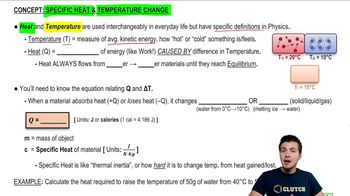
    Temperature measures the kinetic energy of the molecules in a substance. Faster molecular motion corresponds to a higher temperature.
  • In which direction does heat always flow between two objects with different temperatures?

    Heat always flows from the hotter object to the colder object. This continues until both objects reach thermal equilibrium.
  • What happens to the heat transfer (Q) between two objects once they reach thermal equilibrium?

    Once thermal equilibrium is reached, the heat transfer (Q) between the objects becomes zero. No further energy is exchanged due to temperature difference.
  • What does the variable 'C' represent in the equation Q = mCΔT?

    'C' represents the specific heat of the material. It quantifies how much heat is needed to change the temperature of a unit mass by one degree.
  • How does the specific heat of water compare to that of common metals like copper or iron?

    Water has a much higher specific heat than common metals like copper or iron. This means water requires more energy to change its temperature by the same amount.
  • If you heat ice in a microwave, what two changes can occur as energy is added?

    Heating ice can increase its temperature and, at a certain point, cause a phase change from solid to liquid. Both temperature change and phase change require energy input.
  • Why does the temperature difference in Celsius equal the temperature difference in Kelvin when calculating ΔT?

    The size of one degree is the same in both Celsius and Kelvin scales, so the difference (ΔT) is numerically identical. This allows you to use either scale for temperature changes in calculations.
  • What is the unit of specific heat as used in the example calculation for water?

    The unit of specific heat in the example is joules per kilogram per degree Celsius (J/kg·°C). This unit indicates the energy required to raise one kilogram of a substance by one degree Celsius.