How does temperature affect the amount of energy an object gives off?
As temperature increases, the average kinetic energy of the particles in an object increases, causing the object to give off more energy.
What happens to matter when it gets colder?
When matter gets colder, the average kinetic energy of its particles decreases, causing the particles to move more slowly.
What happens to the conductivity of a semiconductor when the temperature increases?
As temperature increases, the conductivity of a semiconductor generally increases because more charge carriers become available.
Which type of object has the most thermal energy: one with a higher temperature or one with a lower temperature, assuming similar mass and material?
An object with a higher temperature has more thermal energy, assuming similar mass and material.
What is the approximate surface temperature of the sun?
The approximate surface temperature of the sun is not specified in the provided materials.
What happens when the temperature of an object increases?
When the temperature of an object increases, the average kinetic energy of its particles increases, causing them to move faster.
Do air particles move faster or slower as the temperature increases?
Air particles move faster as the temperature increases.
How are thermal energy and temperature different?
Temperature measures the average kinetic energy of particles, while thermal energy is the total kinetic energy of all particles in an object.
Which unit of measurement is commonly used to measure thermal energy?
Thermal energy is commonly measured in joules (J).
Why does temperature increase with altitude in the stratosphere?
The provided materials do not specify why temperature increases with altitude in the stratosphere.
What happens to a balloon filled with air when it is placed into a fridge?
When a balloon filled with air is placed into a fridge, the air inside cools, the average kinetic energy of the particles decreases, and the balloon contracts.
What is the difference between thermal energy and temperature?
Thermal energy is the total kinetic energy of all particles in an object, while temperature is a measure of the average kinetic energy of the particles.
What happens when the temperature of an object decreases?
When the temperature of an object decreases, the average kinetic energy of its particles decreases, and the particles move more slowly.
Why does a block of ice feel cold when you touch it?
A block of ice feels cold because it has a lower temperature than your skin, causing heat to flow from your hand to the ice.
What happens to air temperature as you climb to higher altitudes?
As you climb to higher altitudes, air temperature generally decreases.
What happens to the resistance of most common metals as the temperature of the metal increases?
As the temperature of most common metals increases, their electrical resistance increases.
What happens to the temperature of a white shirt in the sunlight compared to a darker shirt?
A white shirt absorbs less sunlight and therefore increases in temperature less than a darker shirt.
What temperature is absolute zero?
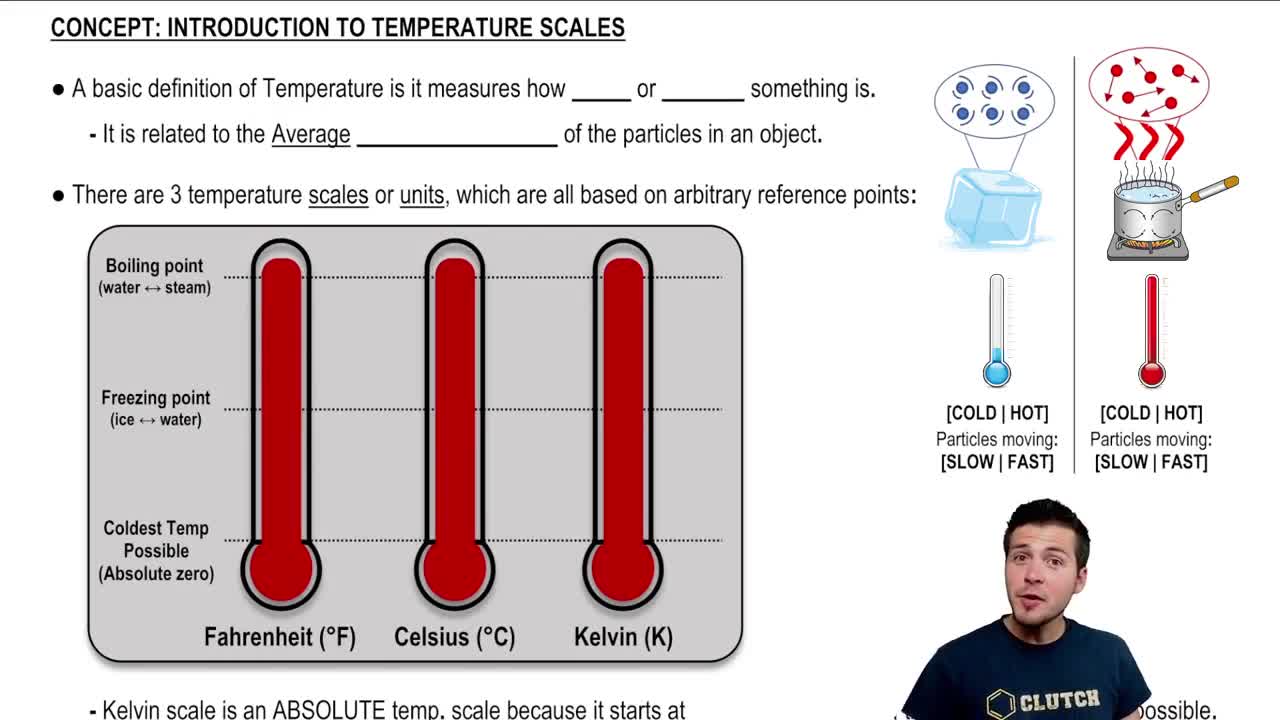
Absolute zero is 0 Kelvin, which is equivalent to -273.15°C or -459.67°F.
How are thermal energy and temperature the same?
Both thermal energy and temperature are related to the kinetic energy of particles, but temperature is the average kinetic energy, while thermal energy is the total kinetic energy.
Why is hot air hot?
Hot air is hot because its particles have a higher average kinetic energy, causing them to move faster.
What are the ordinary and absolute temperature scales in the SI and English systems?
The ordinary temperature scales are Celsius (SI) and Fahrenheit (English), while the absolute temperature scale is Kelvin (SI).
If one star is 125 times brighter than another, how many times hotter is it, assuming brightness is proportional to the fourth power of temperature?
If brightness is proportional to the fourth power of temperature, then the hotter star is (125)^(1/4) = 5 times hotter.
What happens to a fluid when its temperature increases?
When a fluid's temperature increases, the average kinetic energy of its particles increases, causing the particles to move faster.
What is temperature a measure of?
Temperature is a measure of the average kinetic energy of the particles in an object.
How does temperature typically relate to the kinetic energy of particles in a graph?
A graph of temperature versus average kinetic energy of particles would show a direct relationship: as temperature increases, average kinetic energy increases.
If the temperature outside increases by 45°C, what is the equivalent increase in Kelvin?
An increase of 45°C is equivalent to an increase of 45 K, since the size of one degree is the same in both scales.
How do variations in temperature affect an altimeter reading?
Variations in temperature can affect air density, which in turn can affect the accuracy of an altimeter reading.
Is there a limit to how cold things can get?
Yes, the lowest possible temperature is absolute zero (0 K), where particles have minimum kinetic energy.
Which type of material typically warms up fastest when heat is applied: metal, water, or air?
Metals typically warm up fastest when heat is applied because they have lower specific heat capacities compared to water and air.
Does sound travel slowest through cold or warm water?
Sound travels slowest through cold water because the particles move more slowly and are less able to transmit vibrations.
What happens to temperatures at the Earth's surface when solar radiation decreases?
When solar radiation decreases, temperatures at the Earth's surface tend to decrease.
Does hot glass look the same as cold glass?
Hot glass may appear different from cold glass due to heat-induced changes, such as glowing at high temperatures.
What does a burner on a stove produce: temperature, thermal energy, or both?
A burner on a stove produces both temperature (by increasing the average kinetic energy of particles) and thermal energy (by transferring energy to objects).
What is a temperature inversion and what would you expect to experience during one?
A temperature inversion occurs when a layer of warm air sits above cooler air near the ground, which can lead to unusual weather patterns and trapping of pollutants.
What happens when a warm hand is immersed in water that is 70°C?
When a warm hand is immersed in water at 70°C, heat flows from the water to the hand, making the hand feel hot.
Why do roads freeze quickly when they are exposed to cold temperatures?
Roads freeze quickly when exposed to cold temperatures because their surfaces lose heat rapidly, causing the temperature to drop below the freezing point.
Explain how a metal chair can get too hot to sit on when it has been left out in direct sunlight.
A metal chair can get too hot to sit on because metal absorbs solar energy efficiently and has a low specific heat, causing its temperature to rise quickly.
Which is colder: -23 degrees Celsius or -50 degrees Celsius?
-50 degrees Celsius is colder than -23 degrees Celsius.
If several objects are removed from an oven at the same time, how do their temperatures compare?
If several objects are removed from an oven at the same time, their temperatures are approximately equal to the oven's temperature.
True or false: Most conducting materials have different resistances at different temperatures.
True. Most conducting materials have different resistances at different temperatures.
 Back
Back
 04:54
04:54