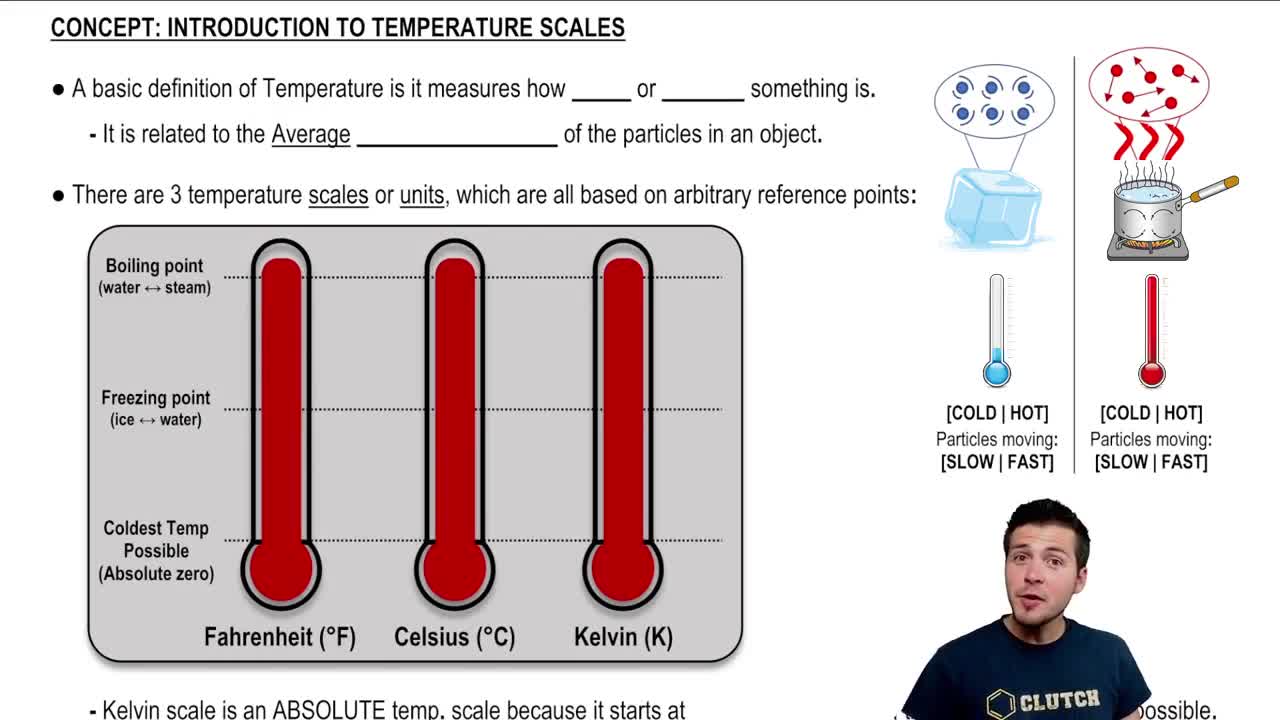
The temperature of an object is directly related to what property of its particles?
The temperature of an object is directly related to the average kinetic energy of its particles.
What is the freezing point of water on the Kelvin scale?
The freezing point of water on the Kelvin scale is 273.15 K. This value is used as a reference point for temperature conversions.
How does the difference between the freezing and boiling points of water compare on the Celsius and Kelvin scales?
The difference between the freezing and boiling points of water is 100 units on both the Celsius and Kelvin scales. This means a change of 1 degree Celsius is equivalent to a change of 1 Kelvin.
What is absolute zero in degrees Celsius and degrees Fahrenheit?
Absolute zero is -273.15°C and -459.67°F. It represents the lowest possible temperature where particle motion stops.
Why is the Kelvin scale considered an absolute temperature scale?
The Kelvin scale is considered absolute because it starts at absolute zero, the lowest possible temperature. This is different from Celsius and Fahrenheit, which have arbitrary zero points.
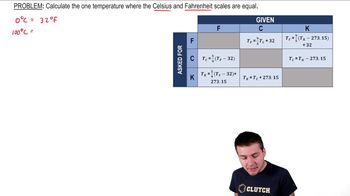
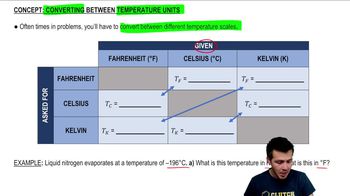
What equation would you use to convert a temperature from Fahrenheit to Celsius?
To convert from Fahrenheit to Celsius, use the equation TC = (5/9)(TF - 32). This equation subtracts 32 from the Fahrenheit value and multiplies by 5/9.
What is the boiling point of water in Kelvin and how is it determined?
The boiling point of water in Kelvin is 373.15 K. It is determined by adding 100 to the freezing point of water in Kelvin (273.15 K).
How do you convert a temperature from Celsius to Kelvin?
To convert from Celsius to Kelvin, add 273.15 to the Celsius temperature. This shifts the scale so that 0 K is absolute zero.
What is unique about expressing temperatures in Kelvin compared to Celsius or Fahrenheit?
When expressing temperatures in Kelvin, you do not use the degree symbol; you simply write K. In contrast, Celsius and Fahrenheit use the degree symbol (°C and °F).
Why can Kelvin temperatures never be negative?
Kelvin temperatures cannot be negative because the scale starts at absolute zero, the lowest possible temperature. All Kelvin values represent temperatures above this absolute minimum.
 Back
Back
 04:54
04:54