Types of Collisions quiz #2 Flashcards

Types of Collisions quiz #2
Control buttons has been changed to "navigation" mode.
1/12
  • What is a likely result of the second collision in a vehicle crash?

    The second collision, where the occupant hits the vehicle interior, can result in injury to the occupant.
  • How frequently do collisions occur in general terms?

    Collisions occur frequently, especially in high-traffic areas, but the exact frequency depends on the context.
  • If a collision is imminent, what should you do to minimize injury?

    If a collision is imminent, you should try to reduce speed and brace for impact to minimize injury.
  • Why do collisions occur at curves on mountains?

    Collisions occur at curves on mountains due to reduced visibility, higher speeds, and difficulty in controlling vehicles on curves.
  • What is considered the worst type of collision to be in?

    The worst type of collision is typically a head-on (frontal) collision due to the high relative speeds and forces involved.
  • How many collisions occur during a crash?

    During a crash, three collisions occur: vehicle with object, occupant with vehicle, and internal organs with occupant's body.
  • If a collision is possible, what should you do to reduce harm?

    If a collision is possible, you should slow down and take actions to minimize the impact.
  • What are the final velocities of two objects after a perfectly elastic collision?

    For a perfectly elastic collision, the final velocities can be found using the equations: v1' = [(m1 - m2)/(m1 + m2)]*v1 + [2m2/(m1 + m2)]*v2; v2' = [2m1/(m1 + m2)]*v1 + [(m2 - m1)/(m1 + m2)]*v2.
  • What is true about inelastic collisions?

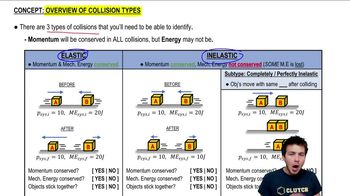
    In inelastic collisions, momentum is conserved but mechanical energy is not; some energy is lost, and the objects may or may not stick together.
  • How do you find the speed of two cars that stick together after a collision?

    The speed is found by conserving momentum: (m1*v1 + m2*v2) / (m1 + m2).
  • What happens when two billiard balls of equal mass undergo a perfectly elastic head-on collision?

    When two billiard balls of equal mass undergo a perfectly elastic head-on collision, they exchange velocities.
  • What is the outcome of a perfectly elastic collision between two perfectly rigid objects?

    In a perfectly elastic collision between two perfectly rigid objects, both momentum and mechanical energy are conserved, and the objects do not stick together.