Skip to main content
Physics with Calculus
My Course
Learn
Exam Prep
AI Tutor
Study Guides
Textbook Solutions
Flashcards
Explore
Try the app
My Course
Learn
Exam Prep
AI Tutor
Study Guides
Textbook Solutions
Flashcards
Explore
Try the app
Back
Vector Composition & Decomposition quiz
You can tap to flip the card.
What three things are needed to fully describe a vector without a grid?
You can tap to flip the card.
👆
What three things are needed to fully describe a vector without a grid?
A vector is described by its magnitude, direction (angle relative to the x-axis), and its components (legs of the triangle).
Track progress
Control buttons has been changed to "navigation" mode.
1/15
Related flashcards
Related practice
Recommended videos
Vector Composition & Decomposition definitions
Vector Composition & Decomposition
15 Terms
Vector Composition & Decomposition
3. Vectors
7 problems
Topic
Patrick
Adding Vectors by Components
3. Vectors
7 problems
Topic
Patrick
3. Vectors - Part 1 of 2
4 topics
9 problems
Chapter
Patrick
3. Vectors - Part 2 of 2
5 topics
13 problems
Chapter
Patrick
Guided course
03:59
Calculating Magnitude & Components of a Vector
13281
views
321
rank
5
comments
Guided course
07:47
Vector Composition & Decomposition
18769
views
364
rank
8
comments
Terms in this set (15)
Hide definitions
What three things are needed to fully describe a vector without a grid?
A vector is described by its magnitude, direction (angle relative to the x-axis), and its components (legs of the triangle).
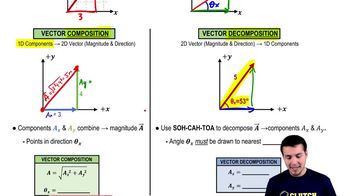
What is vector composition?
Vector composition is when you are given the components of a vector and you calculate the magnitude and direction of the vector.
What is vector decomposition?
Vector decomposition is when you are given the magnitude and direction of a vector and you calculate its components.
How do you calculate the magnitude of a vector from its components?
Use the Pythagorean theorem: magnitude = sqrt((x component)^2 + (y component)^2).
How do you calculate the direction (angle) of a vector from its components?
The direction is found using the inverse tangent (arctangent) of the y-component divided by the x-component: θ = arctan(y/x).
What equation is used to find the x-component of a vector given its magnitude and angle?
The x-component is found using: x = magnitude × cos(angle relative to x-axis).
What equation is used to find the y-component of a vector given its magnitude and angle?
The y-component is found using: y = magnitude × sin(angle relative to x-axis).
Why must the angle used in decomposition be relative to the x-axis?
Because the decomposition equations (using cosine and sine) are based on the angle measured from the x-axis, not the y-axis.
If a vector has components of 3 (x) and 4 (y), what is its magnitude?
The magnitude is 5, calculated as sqrt(3^2 + 4^2).
If a vector has components of 3 (x) and 4 (y), what is its direction relative to the x-axis?
The direction is 53 degrees, found by arctan(4/3).
Given a vector with magnitude 5 and angle 53° relative to the x-axis, what are its x and y components?
The x-component is 3 (5 × cos(53°)), and the y-component is 4 (5 × sin(53°)).
What is the process for finding the magnitude and direction if you are given the x and y components?
Use the Pythagorean theorem for magnitude and arctangent for direction.
What is the process for finding the components if you are given the magnitude and direction?
Multiply the magnitude by the cosine of the angle for the x-component and by the sine of the angle for the y-component.
If a vector has components 8 (x) and 6 (y), what is its magnitude and direction?
The magnitude is 10 (sqrt(8^2 + 6^2)), and the direction is 37° (arctan(6/8)).
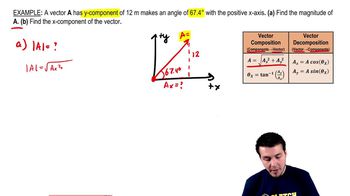
If a vector has magnitude 13 and angle 67.4°, what are its x and y components?
The x-component is 5 (13 × cos(67.4°)), and the y-component is 12 (13 × sin(67.4°)).
 BackBack
 03:59
03:59