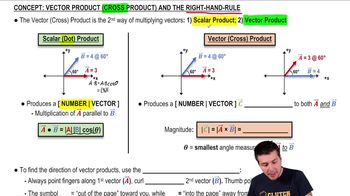
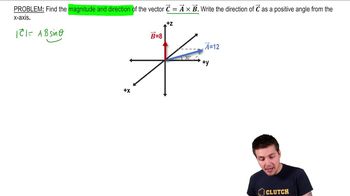
What is the general formula for the magnitude of the cross product of two vectors, A and B?
The magnitude of the cross product of two vectors A and B is |A × B| = |A||B|sin(θ), where θ is the smallest angle between the vectors.
Using the properties of cross products and unit vectors, what is the result of (j − k) × (k − i)?
Expanding (j − k) × (k − i):
(j × k) + (j × −i) + (−k × k) + (−k × −i).
Using unit vector cross product rules:
j × k = i,
j × −i = −(j × i) = −(−k) = k,
−k × k = 0,
−k × −i = k × i = −j.
Sum: i + k − j.
Using the properties of cross products and unit vectors, what is the result of (i + j) × (i − j)?
Expanding (i + j) × (i − j):
(i × i) + (i × −j) + (j × i) + (j × −j).
i × i = 0,
i × −j = −(i × j) = −k,
j × i = −k,
j × −j = 0.
Sum: −k − k = −2k.
Using the properties of cross products and unit vectors, what is the result of (i × j) × k?
First, i × j = k. Then, k × k = 0. So, (i × j) × k = k × k = 0.
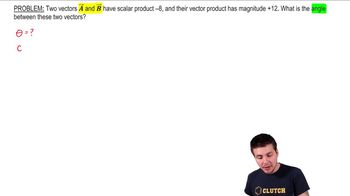
What is the general formula for the magnitude of the cross product of two vectors A and B?
The magnitude of the cross product is |A × B| = |A||B|sin(θ), where θ is the smallest angle between A and B.
Given two vectors A and B, in which direction does the cross product A × B point?
The cross product A × B points in the direction perpendicular to both A and B, as determined by the right-hand rule: point your fingers along A, curl towards B, and your thumb points in the direction of A × B.
Given vectors a = t i + cos(t) j + sin(t) k and b = i − sin(t) j + cos(t) k, what is the cross product a × b?
To find a × b, use the distributive property and unit vector cross product rules:
a × b = (t i + cos(t) j + sin(t) k) × (i − sin(t) j + cos(t) k).
Expand and use:
i × i = 0,
i × j = k,
i × k = −j,
j × i = −k,
j × j = 0,
j × k = i,
k × i = j,
k × j = −i,
k × k = 0.
Combine terms to get the symbolic result.
Using the properties of cross products and unit vectors, what is the result of (i + j) × (i − j)?
Expanding (i + j) × (i − j):
i × i = 0,
i × −j = −k,
j × i = −k,
j × −j = 0.
Sum: −k − k = −2k.
What symbol is commonly used to represent a vector pointing out of the page towards you in cross product diagrams?
A circle with a dot in the center is used to represent a vector pointing out of the page towards you. This symbol visually mimics the tip of an arrow coming toward the observer.
What happens to the magnitude of the cross product when two vectors are parallel or antiparallel?
The magnitude of the cross product becomes zero when the vectors are parallel (angle 0°) or antiparallel (angle 180°). This is because the sine of 0° and 180° is zero, making the entire product zero.
 Back
Back
 04:57
04:57