Wave Functions quiz #2 Flashcards

Wave Functions quiz #2
Control buttons has been changed to "navigation" mode.
1/40
  • What causes the amplitude of a wave to change?
    Amplitude changes when the energy input to the wave changes.
  • What happens if the amplitude of a wave increases?
    If the amplitude increases, the wave carries more energy and the maximum displacement becomes larger.
  • What happens if you decrease the amplitude of a wave?
    Decreasing the amplitude reduces the wave's energy and maximum displacement.
  • Which form of energy is vibrating waves through a substance?
    Mechanical energy is transmitted by vibrating waves through a substance.
  • A wave with a wavelength of 56 m has a frequency of 0.02 Hz. What is its speed?
    Wave speed v = fλ = 0.02 Hz × 56 m = 1.12 m/s.
  • Which change in wave properties increases wave amplitude?
    Increasing the energy input to the wave increases its amplitude.
  • What type of wave does not require a medium to travel through?
    Electromagnetic waves do not require a medium.
  • What is the phase constant in a traveling wave function?
    The phase constant is an additional term added to the argument of the sine or cosine in the wave function, representing an initial phase offset.
  • What is the distance traveled by a wave in one period called?
    The distance traveled in one period is the wavelength.
  • If a transverse wave is traveling from right to left, what direction does the medium vibrate?
    The medium vibrates perpendicular to the direction of wave travel, i.e., up and down.
  • What is the distance between two crests or two troughs on a transverse wave called?
    This distance is called the wavelength.
  • How does changing the amplitude affect the wavelength?
    Changing the amplitude does not affect the wavelength; amplitude and wavelength are independent properties.
  • What must happen to a wave in order for an echo to occur?
    A wave must reflect off a surface and return to its source for an echo to occur.
  • In which type of wave is the disturbance parallel to the direction of wave travel?
    In longitudinal waves, the disturbance is parallel to the direction of wave travel.
  • If the amplitude of a wave increases by a factor of 4, how does its energy change?
    The energy increases by a factor of 16, since energy is proportional to amplitude squared.
  • What do electromagnetic and mechanical waves have in common?
    Both types of waves transfer energy through oscillations.
  • If you increase the frequency of a wave, what happens to the number of waves passing a point per second?
    The number of waves passing a point per second increases.
  • How is amplitude indicated in a wave diagram or function?
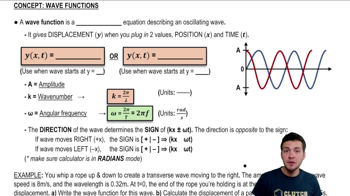
    Amplitude is the maximum displacement from the equilibrium position, represented by the coefficient outside the sine or cosine in the wave function.
  • What happens when the period of a wave is doubled?
    The frequency is halved, since frequency is the inverse of period.
  • How does changing the frequency affect the wavelength?
    If wave speed is constant, increasing frequency decreases wavelength, and vice versa.
  • Which phenomenon can be observed for transverse waves only?
    Transverse waves can exhibit polarization.
  • What are amplitude and wavelength in the context of a wave?
    Amplitude is the maximum displacement from equilibrium; wavelength is the distance between two consecutive points in phase, such as crests.
  • What are periodic waves?
    Periodic waves are waves that repeat at regular intervals, forming a consistent pattern.
  • How does the period of a wave change if the frequency increases by a factor of three?
    The period decreases by a factor of three, since period is the inverse of frequency.
  • A wave is traveling at 4.00 m/s and has a wavelength of 2.20 m. What is its frequency?
    Frequency f = v / λ = 4.00 m/s / 2.20 m ≈ 1.82 Hz.
  • What does it mean when a wave’s amplitude increases?
    An increase in amplitude means the wave's maximum displacement and energy increase.
  • What happens to the frequency of a wave when the amplitude is tripled?
    Frequency does not change when amplitude is tripled; amplitude and frequency are independent.
  • What is the vertical distance between a trough and a crest?
    The vertical distance between a trough and a crest is twice the amplitude.
  • Which part of the wave should be changed to change its frequency?
    To change frequency, adjust the wave speed or wavelength.
  • What is the difference between amplitude and wavelength?
    Amplitude is the maximum displacement from equilibrium; wavelength is the distance between two consecutive points in phase.
  • What does the trough of a wave refer to?
    The trough is the lowest point of a wave below the equilibrium position.
  • What happens to the frequency of a wave if the wavelength increases?
    If wave speed is constant, frequency decreases as wavelength increases.
  • How is the amplitude of a wave correctly defined?
    Amplitude is the maximum extent of a vibration or oscillation, measured from the position of equilibrium.
  • What is the distance from the peak of one wave to the peak of the next wave called?
    This distance is called the wavelength.
  • What can be said about two waves with different amplitudes?
    The wave with the larger amplitude carries more energy.
  • What do vertical and horizontal surface waves have in common?
    Both types of surface waves transfer energy along the interface of two media.
  • How do you determine the number of complete wavelengths in a sound wave?
    Count the number of repeating patterns (cycles) in the wave.
  • How do you determine the number of complete wavelengths present in a sound wave?
    Count the number of full cycles from crest to crest or trough to trough.
  • Which waveform has the shortest period?
    The waveform with the highest frequency has the shortest period.
  • What is the wave base of a wave with a wave height of 3 m and a wavelength of 7 m?
    Wave base is typically half the wavelength, so wave base = 7 m / 2 = 3.5 m.