Control buttons has been changed to "navigation" mode.
1/32
Terms in this set (32)
What occurs when an object takes in a wave as the wave hits it?
The object absorbs the wave's energy.
What is one characteristic shared by electromagnetic and mechanical waves?
Both transfer energy through oscillations.
What is a material that takes in the energy of a wave when the wave hits it called?
Such a material is called an absorber.
In which direction does wave energy travel in the ocean?
Wave energy travels horizontally across the ocean surface.
Which object can an S wave travel through: air, magma, soil, or water?
S waves can travel through solids like soil, but not through liquids or gases.
Which type of wave is the size of a honey bee?
Electromagnetic waves such as visible light can have wavelengths on the order of millimeters, similar to the size of a honey bee.
What is the term for the maximum point of a wave from the baseline?
The maximum point is called the crest.
What happens to a wave when the energy is absorbed?
The wave's amplitude decreases and the wave may be diminished or stopped.
What best describes a transverse wave?
A transverse wave has oscillations perpendicular to the direction of wave travel.
What happens when a wave is acted upon by an external damping force?
The amplitude of the wave decreases over time due to energy loss.
What type of wave activity is shown when a wave passes through a small opening?
This is diffraction, the bending of waves around obstacles or through openings.
What happens if you increase the frequency of a periodic wave?
The number of wave cycles passing a point per second increases, and the period decreases.
What best describes the difference between two sound waves if one has a larger amplitude?
The wave with the larger amplitude is louder and carries more energy.
As the amplitude of a mechanical wave increases, what happens?
The energy carried by the wave increases.
What produces wave particles that move and displace one another?
A disturbance or vibration in a medium produces wave particles that move and displace each other.
How does increasing the tension of a spring affect a wave on the spring?
Increasing the tension increases the wave speed.
What happens when plane waves pass through a small opening in a barrier?
The waves undergo diffraction and spread out after passing through the opening.
As the amplitude of a mechanical wave increases, which quantity increases?
The energy carried by the wave increases.
What is the maximum extent of a vibration or oscillation, measured from the position of equilibrium?
This is the amplitude.
How do remote controls use waves to carry signals and transmit information over short distances?
Remote controls use electromagnetic waves, such as infrared, to transmit signals.
What is a disturbance that transfers energy from place to place?
A wave is a disturbance that transfers energy from place to place.
What is the highest point of a wave called?
The highest point is called the crest.
What is the vocabulary associated with waves?
Key wave vocabulary includes amplitude, wavelength, frequency, period, crest, trough, and wave speed.
What is the matter a wave moves through called?
The matter a wave moves through is called the medium.
What is the material through which a wave travels called?
The material is called the medium.
What is the bending of waves caused by a change in speed called?
This phenomenon is called refraction.
In any transverse wave, the energy moves ____________ to the particles of the medium.
In any transverse wave, the energy moves perpendicular to the particles of the medium.
What is the part of a longitudinal wave where the particles of the medium are close together called?
This part is called a compression.
What happens when a loudspeaker on a tall pole broadcasts sound waves equally in all directions?
Sound waves propagate outward in all directions, transferring energy through the air.
How are the transverse displacements for a traveling wave given?
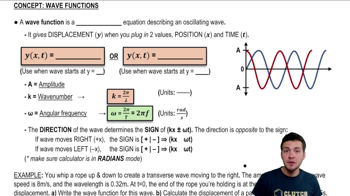
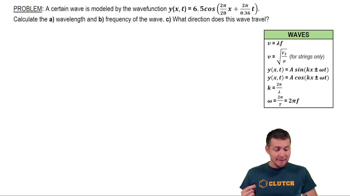
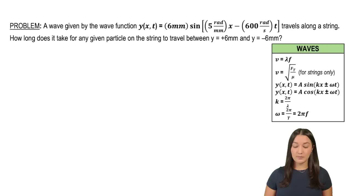
Transverse displacements are given by the wave function y(x, t) = A sin(kx ± ωt) or y(x, t) = A cos(kx ± ωt).
How is the period of a waveform determined?
The period is the time it takes for one complete cycle of the wave to pass a point.
How is a traveling wave along the x-axis described mathematically?
A traveling wave along the x-axis is described by y(x, t) = A sin(kx ± ωt) or y(x, t) = A cos(kx ± ωt), where A is amplitude, k is wave number, and ω is angular frequency.