Ch 03: Motion in Two or Three Dimensions
Chapter 3, Problem 38a

An airplane pilot wishes to fly due west. A wind of 80.0 km/h (about 50 mi/h) is blowing toward the south. If the airspeed of the plane (its speed in still air) is 320.0 km/h (about 200 mi/h), in which direction should the pilot head?

Verified step by step guidance
1
Start by identifying the vectors involved: the wind vector blowing south at 80.0 km/h and the airplane's airspeed vector at 320.0 km/h.
To fly due west, the pilot needs to counteract the southward wind. This requires calculating the resultant vector that combines the airplane's airspeed and the wind vector.
Use vector addition to find the direction the pilot should head. The wind vector can be represented as \( \mathbf{v}_{\text{wind}} = (0, -80) \) km/h, and the airplane's airspeed vector as \( \mathbf{v}_{\text{plane}} = (v_x, v_y) \) km/h.
Set up the equation for vector addition: \( \mathbf{v}_{\text{resultant}} = \mathbf{v}_{\text{plane}} + \mathbf{v}_{\text{wind}} \). The resultant vector should have a westward direction, meaning \( v_y = 0 \).
Solve for \( v_x \) and \( v_y \) using the Pythagorean theorem: \( v_x^2 + v_y^2 = 320^2 \). Substitute \( v_y = 80 \) to find \( v_x \), and then calculate the angle using trigonometry: \( \theta = \tan^{-1}(\frac{v_y}{v_x}) \). This angle will give the direction the pilot should head.

Verified video answer for a similar problem:

This video solution was recommended by our tutors as helpful for the problem above.
Video duration:
1m
Was this helpful?

Key Concepts

Here are the essential concepts you must grasp in order to answer the question correctly.

Vector Addition

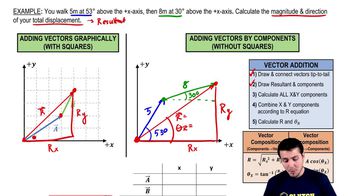
Vector addition is a method used to combine two or more vectors to determine a resultant vector. In this scenario, the airplane's velocity vector and the wind's velocity vector must be added to find the direction the pilot should head to achieve a westward trajectory. This involves breaking down vectors into components and using trigonometric functions to solve for the resultant direction.
Recommended video:
Guided course
07:30
Vector Addition By Components

Relative Velocity

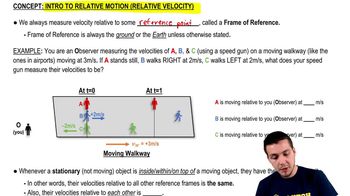
Relative velocity is the velocity of an object as observed from a particular frame of reference. Here, the pilot must consider the relative velocity of the airplane with respect to the ground, factoring in the wind's influence. The concept helps in understanding how the airplane's airspeed and the wind's speed interact to affect the actual path and speed over the ground.
Recommended video:
Guided course
04:27
Intro to Relative Motion (Relative Velocity)

Trigonometry in Physics

Trigonometry is essential in physics for resolving vectors into components and calculating angles. In this problem, trigonometric functions such as sine, cosine, and tangent are used to determine the angle at which the pilot should head to counteract the wind's effect and maintain a westward course. Understanding these functions allows for precise calculation of direction and magnitude.
Recommended video:
Guided course
3:26
Trigonometry