
Two uniform spheres, each with mass M and radius R, touch each other. What is the magnitude of their gravitational force of attraction?
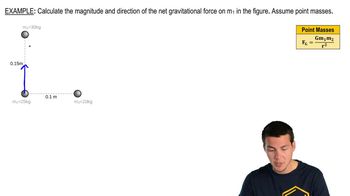
Find the magnitude and direction of the net gravitational force on mass A due to masses B and C in Fig. E13.6. Each mass is 2.00 kg.

Verified step by step guidance
Verified video answer for a similar problem:
Key Concepts
Gravitational Force
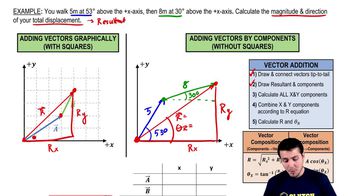
Vector Addition
Equilibrium and Net Force
Two uniform spheres, each of mass 0.260 kg, are fixed at points A and B (Fig. E13.5). Find the magnitude and direction of the initial acceleration of a uniform sphere with mass 0.010 kg if released from rest at point P and acted on only by forces of gravitational attraction of the spheres at A and B.
A typical adult human has a mass of about 70 kg. (a) What force does a full moon exert on such a human when it is directly overhead with its center 378,000 km away? (b) Compare this force with the force exerted on the human by the earth
The point masses m and 2m lie along the x-axis, with m at the origin and 2m at x = L. A third point mass M is moved along the x-axis. At what point is the net gravitational force on M due to the other two masses equal to zero?
At what distance above the surface of the earth is the acceleration due to the earth's gravity 0.980 m/s2 if the acceleration due to gravity at the surface has magnitude 9.80 m/s2 ?
