Skip to main content
Precalculus
My Course
Learn
Exam Prep
AI Tutor
Study Guides
Flashcards
Explore
Try the app
My Course
Learn
Exam Prep
AI Tutor
Study Guides
Flashcards
Explore
Try the app
Back
Graphing Parametric Equations quiz
You can tap to flip the card.
What is a parametric equation?
You can tap to flip the card.
👆
What is a parametric equation?
A parametric equation expresses x and y in terms of a third variable, usually called t, the parameter.
Track progress
Control buttons has been changed to "navigation" mode.
1/15
Related flashcards
Related practice
Recommended videos
Graphing Parametric Equations definitions
Graphing Parametric Equations
15 Terms
Graphing Parametric Equations
16. Parametric Equations
3 problems
Topic
Eliminate the Parameter
16. Parametric Equations
3 problems
Topic
16. Parametric Equations
3 topics
2 problems
Chapter
04:47
Introduction to Parametric Equations
510
views
14
rank
Terms in this set (15)
Hide definitions
What is a parametric equation?
A parametric equation expresses x and y in terms of a third variable, usually called t, the parameter.
How are x and y written in parametric equations?
They are written as x(t) and y(t), meaning x and y are functions of t.
What is the main difference between standard equations and parametric equations?
Standard equations have one equation with two variables, while parametric equations have two equations with three variables: x, y, and t.
What is the first step in graphing parametric equations?
The first step is to create a table of values for t, x(t), and y(t) to obtain coordinate pairs.
How do you obtain x and y values from parametric equations?
You input values of t into the x(t) and y(t) equations to calculate the corresponding x and y values.
What do you do after finding coordinate pairs from parametric equations?
You plot the points on the graph and connect them with a curve or line.
What are graphs of parametric equations called?
They are called plane curves, which can be lines, parabolas, or other shapes.
How is the direction or orientation of a parametric graph indicated?
The direction is shown with arrows along the curve, indicating the path as t increases.
Does t have its own axis on the graph of parametric equations?
No, t does not have a dedicated axis; it is represented by labeling corresponding t values with their coordinates.
Why is it important to label t values on the graph?
Labeling t values helps identify which coordinate pairs correspond to which t values, since t is not shown on the axes.
What happens if you graph x(t) = t + 1 and y(t) = 2t - 1 for t = 1, 2, 3?
You get the points (2,1), (3,3), and (4,5), which you plot and connect.
How is graphing parametric equations similar to graphing standard equations?
Both involve plotting coordinate pairs and connecting them, but parametric equations use t to generate x and y.
What shapes can parametric equations represent?
They can represent lines, curves, parabolas, and more complex shapes.
How do you show the orientation of a parametric curve?
By drawing arrows along the curve in the direction that t increases.
What is the role of the parameter t in parametric equations?
T acts as an input that determines the values of x and y, guiding the plotting of points on the graph.
 BackBack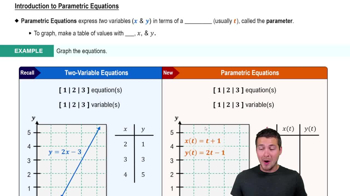
 04:47
04:47