Skip to main content
Precalculus
My Course
Learn
Exam Prep
AI Tutor
Study Guides
Flashcards
Explore
Try the app
My Course
Learn
Exam Prep
AI Tutor
Study Guides
Flashcards
Explore
Try the app
Back
The Imaginary Unit quiz
You can tap to flip the card.
What is the imaginary unit, and what is its value?
You can tap to flip the card.
👆
What is the imaginary unit, and what is its value?
The imaginary unit is denoted as i, and its value is the square root of -1.
Track progress
Control buttons has been changed to "navigation" mode.
1/15
Related flashcards
Related practice
Recommended videos
The Imaginary Unit definitions
The Imaginary Unit
13 Terms
The Imaginary Unit
1. Equations and Inequalities
4 problems
Topic
Powers of i
1. Equations and Inequalities
3 problems
Topic
1. Equations and Inequalities - Part 1 of 2
7 topics
13 problems
Chapter
1. Equations and Inequalities - Part 2 of 2
5 topics
12 problems
Chapter
Guided course
05:02
Square Roots of Negative Numbers
1331
views
39
rank
1
comments
Terms in this set (15)
Hide definitions
What is the imaginary unit, and what is its value?
The imaginary unit is denoted as i, and its value is the square root of -1.
How do you write the square root of -1 using the imaginary unit?
The square root of -1 is written as i.
How do you simplify the square root of a negative number, such as -b?
You write it as i times the square root of the positive number, or i√b.
What is the simplified form of √(-4)?
The simplified form is 2i.
How do you write the answer when you have a whole number and the imaginary unit?
Write the whole number first, then the imaginary unit, for example, 2i.
What is the simplified form of √(-17)?
The simplified form is i√17.
When simplifying √(-32), what is the final answer?
The final answer is 4i√2.
Why do we use the imaginary unit i?
We use i to evaluate the square roots of negative numbers, which are not real.
What is the general form for the square root of any negative number?
The general form is i times the square root of the positive number, or i√b.
How should you write your answer if it includes both a whole number and a radical with i?
Write the whole number first, then i, then the radical, such as 4i√2.
What do you call numbers that include the imaginary unit i?
Numbers that include i are called imaginary numbers.
Why shouldn't you write √17i instead of i√17?
Writing √17i is confusing because it's unclear if i is under the radical; write i√17 instead.
What is the value of i squared (i^2)?
i squared equals -1.
If you have √(-b), and b is positive, how do you express it using i?
Express it as i√b.
What is the first step in simplifying the square root of a negative number?
Factor the negative number as -1 times the positive number, then use i for √(-1).
 BackBack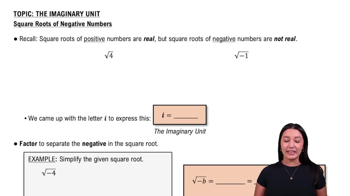
 05:02
05:02