Skip to main content
Introduction to Psychology
My Course
Learn
Exam Prep
AI Tutor
Study Guides
Flashcards
Explore
Try the app
My Course
Learn
Exam Prep
AI Tutor
Study Guides
Flashcards
Explore
Try the app
Back
Attachment definitions
You can tap to flip the card.
Attachment Theory
You can tap to flip the card.
👆
Attachment Theory
A framework from evolutionary psychology explaining the emotional bond between children and caregivers, shaping social and emotional development.
Track progress
Control buttons has been changed to "navigation" mode.
1/15
Related flashcards
Related practice
Recommended videos
Attachment quiz #1
Attachment
40 Terms
Attachment quiz #2
Attachment
11 Terms
Attachment
10. Developmental Psychology
7 problems
Topic
Parenting Styles
10. Developmental Psychology
7 problems
Topic
10. Developmental Psychology
3 topics
10 problems
Chapter
Nicole
Guided course
03:13
History of Attachment
478
views
10
rank
Guided course
04:23
Bowlby's Theory of Attachment
460
views
6
rank
Guided course
01:43
Example 3
338
views
5
rank
Terms in this set (15)
Hide definitions
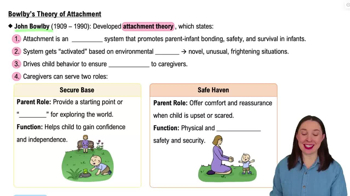
Attachment Theory
A framework from evolutionary psychology explaining the emotional bond between children and caregivers, shaping social and emotional development.
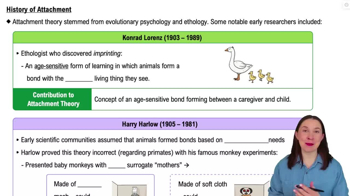
Imprinting
An age-sensitive learning process where certain animals form a bond with the first object they encounter, crucial for early attachment.
Ethology
The scientific study of animal behavior, providing foundational insights for understanding human attachment.
Secure Base
A caregiver's role as a reliable starting point, allowing a child to explore the world with confidence and independence.
Safe Haven
A caregiver's function of providing comfort and reassurance during times of distress, ensuring emotional and physical safety.
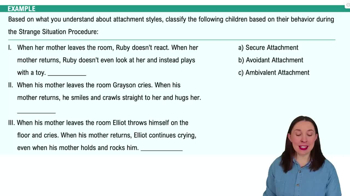
Strange Situation Procedure
A laboratory method involving separations and reunions to assess attachment styles in infants based on their reactions.
Secure Attachment
A style marked by distress during separation and easy comfort upon reunion, linked to sensitive and responsive caregiving.
Ambivalent Attachment
A style where children show distress at separation but are difficult to soothe or act angrily upon reunion, often due to inconsistent caregiving.
Avoidant Attachment
A style where children show little distress at separation and ignore caregivers upon reunion, associated with emotionally distant caregiving.
Disorganized Attachment
A rare style with inconsistent or confused behaviors, typically observed in cases of abuse or neglect.
Internal Working Models
Cognitive schemas about self, others, and relationships, shaped by early caregiver interactions and influencing future social outcomes.
Insecure Attachment
A category including ambivalent, avoidant, and disorganized styles, generally linked to less optimal social and emotional outcomes.
Caregiving
Parenting behaviors, such as sensitivity and responsiveness, that strongly influence the development of attachment styles.
Temperament
Individual differences in personality or emotional reactivity that can affect attachment style and responses in attachment assessments.
Trajectory
A developmental path, positive or negative, set by early attachment experiences and influencing later social and emotional outcomes.
 BackBack
 03:13
03:13