Skip to main content
Introduction to Psychology
My Course
Learn
Exam Prep
AI Tutor
Study Guides
Flashcards
Explore
Try the app
My Course
Learn
Exam Prep
AI Tutor
Study Guides
Flashcards
Explore
Try the app
Back
Diagnosing Psychological Disorders quiz #4
You can tap to flip the card.
What is not normally affected by long-term alcohol use?
You can tap to flip the card.
👆
What is not normally affected by long-term alcohol use?
Functions unrelated to cognition, emotion, or behavior are not normally affected.
Track progress
Control buttons has been changed to "navigation" mode.
1/40
Related flashcards
Related practice
Recommended videos
Diagnosing Psychological Disorders quiz #1
Diagnosing Psychological Disorders
38 Terms
Diagnosing Psychological Disorders quiz #2
Diagnosing Psychological Disorders
39 Terms
Diagnosing Psychological Disorders quiz #3
Diagnosing Psychological Disorders
38 Terms
Diagnosing Psychological Disorders
14. Psychological Disorders
7 problems
Topic
Nicole
Perspectives on Psychological Disorders
14. Psychological Disorders
7 problems
Topic
Nicole
14. Psychological Disorders
5 topics
11 problems
Chapter
Nicole
Guided course
01:55
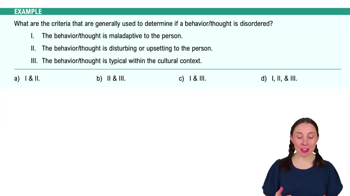
Example 3
574
views
1
rank
Guided course
00:55
Example 1
474
views
10
rank
Guided course
04:55
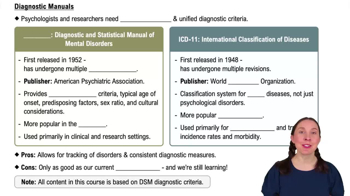
Diagnostic Manuals
490
views
4
rank
Terms in this set (40)
Hide definitions
What is not normally affected by long-term alcohol use?
Functions unrelated to cognition, emotion, or behavior are not normally affected.
What are helpful interventions for a patient with aphasia following a stroke?
Supportive communication strategies and rehabilitation are helpful.
What is not a symptom of anorexia nervosa?
Symptoms unrelated to restrictive eating or weight loss are not symptoms of anorexia nervosa.
What is a major problem with intelligence tests mentioned in the text?
Intelligence tests may not fully capture the complexity of cognitive functioning.
What behavior change is not common in drug abusers?
Behavior changes unrelated to maladaptive substance use are not common.
What is not an effect of taking steroids?
Effects unrelated to physical or psychological functioning are not effects of steroids.
Which type of seizure affects both sides of the brain?
Generalized seizures affect both sides of the brain.
What behavior is one of the warning signs of suicide?
Withdrawal from social activities and expressions of hopelessness are warning signs.
What are the three main symptoms of autism?
Impairment in social communication, restricted interests, and repetitive behaviors are main symptoms.
What is false of dissociative disorders?
A statement that dissociative disorders do not cause distress or impairment is false.
How are individuals diagnosed as having personality disorders best characterized?
They exhibit maladaptive, distressing, and atypical patterns of behavior.
What is the central focus of persecutory delusions?
The belief that one is being targeted or persecuted by others.
What is the main difference between generalized anxiety disorder and phobic disorder?
Generalized anxiety disorder involves pervasive worry, while phobic disorder involves fear of specific objects or situations.
What exemplifies a symptom of paranoid personality disorder?
Suspiciousness and mistrust of others exemplify paranoid personality disorder.
What best illustrates a negative symptom of schizophrenia?
Social withdrawal and lack of motivation are negative symptoms.
What behavior would qualify for an emergency inpatient psychiatric evaluation?
Behavior that poses immediate risk to self or others qualifies for emergency evaluation.
What observation is not a reason to suspect physical abuse?
Observations unrelated to distress or impairment are not reasons to suspect abuse.
What is alcohol abuse?
Alcohol abuse is maladaptive use of alcohol causing distress or impairment.
What is the most likely classification of Annie's problems?
Annie's problems may be classified as a psychological disorder if they cause distress and impairment.
What is the most common disorder found in clients diagnosed with bulimia nervosa?
Mood disorders, such as depression, are commonly comorbid.
What is the least common mental health problem of those listed?
A disorder with the lowest prevalence according to standardized criteria is least common.
What exemplifies a symptom of schizotypal personality disorder?
Odd beliefs and eccentric behavior exemplify schizotypal personality disorder.
How is the idea that psychological disorders can be diagnosed and treated described?
Psychological disorders are diagnosed using standardized criteria and can be treated with appropriate interventions.
What effect will Katerina most likely experience after being raped?
Katerina may experience significant distress and impairment, such as symptoms of PTSD.
What is a typical nonverbal sign of elder abuse?
Withdrawal, unexplained injuries, or changes in behavior are nonverbal signs.
Who is most likely to have memory difficulties?
Individuals with cognitive impairment, such as dementia, are most likely.
What best describes the primary goal of treatment for obsessive-compulsive disorder?
The primary goal is to reduce distress and impairment caused by obsessions and compulsions.
What is the most dangerous time period following a previous suicide attempt?
The period immediately following a previous attempt is most dangerous.
What is inconsistent with panic-level anxiety?
Behaviors that do not involve intense fear or impairment are inconsistent.
Which mental disorder is characterized by extreme withdrawal and abnormal absorption in fantasy?
Schizophrenia is characterized by extreme withdrawal and abnormal absorption in fantasy.
What is not an accurate portrayal of antisocial personality disorder?
A portrayal that does not include maladaptive, distressing, and atypical behavior is not accurate.
Which person is least likely to obtain psychological treatment?
A person whose behavior does not cause distress or impairment is least likely.
Which factors may lead to the development of a dissociative disorder?
Significant psychological stress or trauma may contribute.
What is typically not a behavior that presages violence?
Behaviors unrelated to distress or impairment are not typical precursors.
Which scenario best describes a binge-eating episode under DSM-5 criteria?
Eating a large amount of food in a short period with distress and no compensatory behaviors.
What is true regarding the treatment of substance use disorder?
Treatment should address maladaptive patterns and aim to reduce distress and impairment.
What is true regarding dissociative disorders?
Dissociative disorders involve significant disturbance in cognition, emotion, or behavior.
What is generally true about help for mental health problems?
Professional help is recommended when distress or impairment is present.
What can cause a developmental disability?
Biological, psychological, or environmental factors can cause developmental disability.
What is a problem associated with informant ratings?
Informant ratings may be biased or inaccurate.
 BackBack
 01:55
01:55