Skip to main content
Introduction to Psychology
My Course
Learn
Exam Prep
AI Tutor
Study Guides
Flashcards
Explore
Try the app
My Course
Learn
Exam Prep
AI Tutor
Study Guides
Flashcards
Explore
Try the app
Back
Diagnosing Psychological Disorders quiz #6
You can tap to flip the card.
What became a problem after the de-institutionalization movement of the 1970s?
You can tap to flip the card.
👆
What became a problem after the de-institutionalization movement of the 1970s?
Lack of adequate community support for individuals with psychological disorders.
Track progress
Control buttons has been changed to "navigation" mode.
1/39
Related flashcards
Related practice
Recommended videos
Diagnosing Psychological Disorders quiz #1
Diagnosing Psychological Disorders
38 Terms
Diagnosing Psychological Disorders quiz #2
Diagnosing Psychological Disorders
39 Terms
Diagnosing Psychological Disorders quiz #3
Diagnosing Psychological Disorders
38 Terms
Diagnosing Psychological Disorders
14. Psychological Disorders
7 problems
Topic
Nicole
Perspectives on Psychological Disorders
14. Psychological Disorders
7 problems
Topic
Nicole
14. Psychological Disorders
5 topics
11 problems
Chapter
Nicole
Guided course
01:55
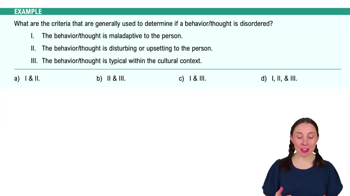
Example 3
580
views
1
rank
Guided course
00:55
Example 1
477
views
10
rank
Guided course
04:55
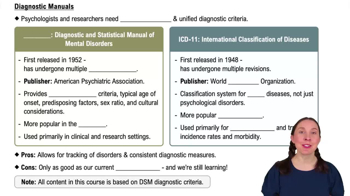
Diagnostic Manuals
491
views
4
rank
Terms in this set (39)
Hide definitions
What became a problem after the de-institutionalization movement of the 1970s?
Lack of adequate community support for individuals with psychological disorders.
What is not a symptom of anorexia nervosa?
Symptoms unrelated to restrictive eating or weight loss are not symptoms.
What is not a major characteristic of substance dependence?
Characteristics unrelated to maladaptive substance use are not major.
What is true about narcissistic personality disorder?
Narcissistic personality disorder involves maladaptive patterns of grandiosity and lack of empathy.
What assessment finding would the nurse observe in a client with bipolar disorder?
Elevated mood, increased energy, and impaired judgment.
What is least likely to be a sign of a psychiatric emergency?
Behaviors unrelated to immediate risk are least likely.
What is the difference between voluntary and involuntary commitment?
Voluntary commitment is chosen by the individual; involuntary is mandated due to risk.
How do doctors distinguish between Parkinson disease and Parkinson syndrome?
By assessing specific symptoms and underlying causes.
What is not usually a primary concern of women seeking addictions treatment?
Concerns unrelated to distress or impairment are not primary.
What is most descriptive of antisocial personality disorder?
A lack of conscience and disregard for others' rights.
Which scenario best describes a manic episode?
Elevated mood, increased energy, and impaired judgment over a set time frame.
Who would be considered a good candidate for psychoanalysis?
A person with insight-oriented psychological issues.
What did the nurse observe in a patient with an atonic seizure?
Sudden loss of muscle tone and collapse.
What is not a criterion to establish a psychological disorder?
Criteria unrelated to distress, impairment, or atypicality are not valid.
What is not a subtype of schizophrenia?
A subtype not defined by standardized criteria is not a subtype.
What client is being treated with a typical antipsychotic?
A client with a psychotic disorder such as schizophrenia.
What statement concerning antisocial personality disorder is not correct?
A statement that does not reflect maladaptive, distressing, and atypical behavior is not correct.
What is a difference between bulimia nervosa and binge eating disorder?
Bulimia nervosa involves compensatory behaviors; binge eating disorder does not.
Why does it make sense to view addiction as a mental disorder?
Addiction involves maladaptive patterns causing distress and impairment.
What does delinquency refer to?
Delinquency refers to actions by adolescents that break the law.
Which mental disorder is most likely to lead to poverty?
Severe mental disorders causing significant impairment, such as schizophrenia.
What is a positive symptom of schizophrenia?
Hallucinations and delusions are positive symptoms.
Which is not a symptom of dissociative identity disorder?
Symptoms unrelated to identity disturbance are not symptoms.
Which is not a common symptom of all dissociative disorders?
Symptoms unrelated to cognition, emotion, or behavior are not common.
Is deviance always considered a crime?
No, deviance is not always considered a crime.
What is a positive symptom of schizophrenia?
Hallucinations and delusions are positive symptoms.
What is the loss of the ability to speak, write, or comprehend called?
This is called aphasia.
What best captures the relationship between a fear and a phobia?
A phobia is an excessive, irrational fear causing distress and impairment.
What is a loss or decline in mental function called?
This is called cognitive impairment or dementia.
Which situation most clearly illustrates a person having a cognitive problem?
Difficulty with memory, attention, or decision-making illustrates a cognitive problem.
Schizophrenia is an example of what type of disorder?
Schizophrenia is a psychotic disorder.
Psychopathology includes illnesses or disorders that involve which symptoms?
Psychopathology involves symptoms of cognition, emotion, or behavior.
A depressive disorder is classified as what type of disorder?
A depressive disorder is classified as a mood disorder.
How may behaviors be classified as abnormal?
Behaviors are abnormal if they are maladaptive, distressing, and atypical.
What is the definition of positive symptoms?
Positive symptoms are excesses or distortions of normal functioning, such as hallucinations.
Women constitute approximately what percent of those suffering from generalized anxiety disorder?
Women constitute a higher percentage, but the exact figure is not provided.
Based on age of onset, when is anorexia nervosa most likely to begin?
Anorexia nervosa most often begins in adolescence.
What is the most commonly diagnosed learning disorder?
Dyslexia is the most commonly diagnosed learning disorder.
What is true concerning behavioral emergencies?
Behavioral emergencies involve immediate risk to self or others.
 BackBack
 01:55
01:55