Skip to main content
Introduction to Psychology
My Course
Learn
Exam Prep
AI Tutor
Study Guides
Flashcards
Explore
Try the app
My Course
Learn
Exam Prep
AI Tutor
Study Guides
Flashcards
Explore
Try the app
Back
Emotion quiz #6
You can tap to flip the card.
What you can see of a person's response to the environment is called what?
You can tap to flip the card.
👆
What you can see of a person's response to the environment is called what?
It is called behavioral expression.
Track progress
Control buttons has been changed to "navigation" mode.
1/39
Related flashcards
Related practice
Recommended videos
Emotion quiz #1
Emotion
37 Terms
Emotion quiz #2
Emotion
39 Terms
Emotion quiz #3
Emotion
39 Terms
Emotion
9. Emotion and Motivation
7 problems
Topic
Nicole
Appraisals and Action Tendencies
9. Emotion and Motivation
7 problems
Topic
Nicole
9. Emotion and Motivation
3 topics
9 problems
Chapter
Nicole
Guided course
03:15
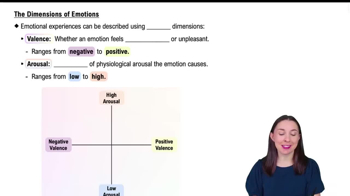
The Dimensions of Emotions
786
views
6
rank
Guided course
02:55
Emotion
934
views
8
rank
Guided course
01:10
Emotion Example 1
731
views
4
rank
Terms in this set (39)
Hide definitions
What you can see of a person's response to the environment is called what?
It is called behavioral expression.
Emotions are reactions triggered by what?
Emotions are triggered by events or thoughts.
The key to contentment is gratitude. True or false?
True.
Think of the amygdala as the screaming what?
The amygdala can be thought of as the screaming center of the brain for emotion.
The use of encouraging body language might include what?
It might include smiling, nodding, and open posture.
A group of responses with the same function is called what?
It is called an emotion or emotional response.
What level of human behavior involves our feelings of importance?
Emotional level involves our feelings of importance.
A person who is influenced by a strong emotion may do what?
They may act impulsively or experience intense physiological changes.
The functional system that processes emotions and allows us to experience them is called what?
It is called the limbic system.
Emotional responses are regulated in which part of the brain?
They are regulated in the limbic system, including the amygdala.
Emotions are controlled primarily by what?
Emotions are controlled primarily by the brain, especially the limbic system.
Knowing your feelings in the moment is referred to as what?
It is referred to as self-awareness.
Is the experience that represents the inner, mental life?
Emotion is the experience that represents the inner, mental life.
Varying the tone of your voice when speaking is called what?
It is called vocal expression or prosody.
We tend to feel cheerful around happy people and sad around depressed people. What does this illustrate?
This illustrates emotional contagion.
Emotions influence driving because they do what?
Emotions influence driving by affecting attention, decision-making, and reaction time.
This is the emotional feelings and associations that go beyond the dictionary definition of a word.
This is called connotation.
The more complex your emotions are, what happens?
The more complex your emotions are, the more cognitive processing is involved.
The view that human emotions are universal has been supported by studies of what?
It has been supported by studies of facial expressions across cultures.
Having good friends can improve your happiness, which can in turn do what?
It can improve your overall well-being.
Those with good emotional health do what?
They express emotions appropriately and maintain positive relationships.
Describe a situation in which a person's voice would communicate emotion.
A raised voice during an argument communicates anger.
The facial expressions associated with particular emotions are what?
They are universal across cultures for basic emotions.
Aiding in emotional processing and arousal functions are functions of what?
They are functions of the limbic system.
Recognizing and understanding the emotions of others is a component of what?
It is a component of emotional intelligence.
What is a feeling of anticipated distress, danger, or hurt?
This feeling is called anxiety or fear.
Procrastinators can develop feelings of what?
Procrastinators can develop feelings of guilt.
What is the impact of the words 'quiet and contemplative'?
They create a calm and thoughtful mood.
Managing your emotions can help you do what?
It can help you maintain well-being and improve relationships.
How do you appear when your words and facial expression match?
You appear genuine and trustworthy.
The neurotransmitter that is primarily associated with the feeling of wanting something is what?
Dopamine is associated with the feeling of wanting something.
How does fear drive action?
Fear increases arousal and motivates avoidance or protective behaviors.
How does the brain influence your emotions, thoughts, and values?
The brain integrates physiological, cognitive, and behavioral processes to shape emotions, thoughts, and values.
What is the author's attitude toward the subject of a text called?
It is called tone.
What does affective forecasting refer to and how accurate is it?
Affective forecasting refers to predicting one's future emotional states, which is often inaccurate.
How many primary emotions do infants experience?
Infants experience several primary emotions, such as anger, sadness, and excitement.
Which dimension of wellness includes optimism, trust, and self-confidence?
The emotional dimension of wellness includes these traits.
What are indicators of a healthy level of emotional intelligence?
Indicators include self-awareness, emotional regulation, and empathy.
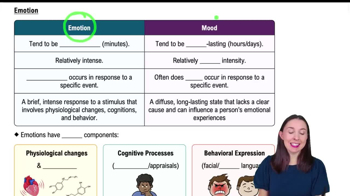
Body language and facial expression are examples of which component of emotion?
They are examples of behavioral expression.
 BackBack
 03:15
03:15