What is a principal component of the psychodynamic perspective?
A principal component is the influence of unconscious motives and conflicts on behavior.
What is the goal of psychodynamic therapy?
The goal of psychodynamic therapy is to help the client become aware of unconscious conflicts and resolve them.
Which famous psychodynamic theorists besides Freud are mentioned in the video?
Other notable psychodynamic theorists include Alfred Adler, Erik Erikson, Carl Jung, and Anna Freud. The course focuses primarily on Freud's contributions.
At what age does Freud believe the superego begins to develop?
Freud believed the superego develops around age five. This is after the ego has already begun to form.
What is the primary function of the ego according to Freud's theory?
The ego's primary function is to mediate between the id's desires and the superego's expectations. It uses rationality and reason to balance these forces.
How are Freud's three personality components represented in the iceberg analogy?
In the iceberg analogy, the id is fully underwater (unconscious), while the ego and superego are both above and below water (conscious and unconscious). This illustrates their levels of awareness.
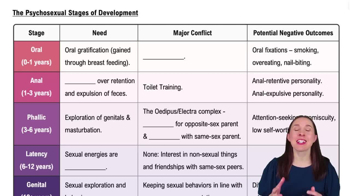
What is the main conflict during the anal stage of Freud's psychosexual theory?
The main conflict during the anal stage is toilet training, where children must learn to control their bodily functions. Failure to resolve this conflict can lead to anal retentive or anal explosive personalities.
What is the Oedipus complex and during which psychosexual stage does it occur?
The Oedipus complex involves a child's desire for the opposite-sex parent and rivalry with the same-sex parent. It occurs during the phallic stage, between ages 3 and 6.
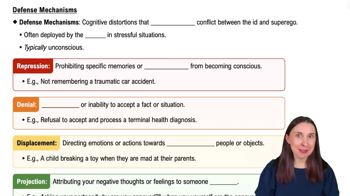
Which defense mechanism involves unconsciously replacing threatening desires with their opposite?
Reaction formation is the defense mechanism where threatening inner desires are unconsciously replaced with the opposite feeling. An example is acting homophobic to counter same-sex attraction.
What is one major limitation of Freud's theories regarding scientific testing?
A major limitation is that many concepts, such as the id and ego, are impossible to empirically test. This makes it difficult to validate Freud's theories scientifically.
What does the psychodynamic school of psychology emphasize in its approach to personality?
The psychodynamic school of psychology emphasizes the influence of unconscious conflicts and motivations on personality, focusing on the dynamic interplay between unconscious desires, societal expectations, and internal psychological structures.
How did Freud conceptualize patients with conversion disorder within his psychodynamic theory?
Freud conceptualized patients with conversion disorder as individuals experiencing unconscious psychological conflicts that manifest as physical symptoms, reflecting unresolved internal tensions between the id, ego, and superego.
Which psychological perspective places a strong emphasis on unconscious thought and motivations?
The psychodynamic perspective places a strong emphasis on unconscious thought and motivations, highlighting the role of unconscious processes in shaping behavior and personality.
What field was the primary focus of Sigmund Freud's work?
Sigmund Freud's primary focus was on personality psychology and developmental psychology, particularly the development of theories explaining personality formation and the impact of childhood experiences.
What is an example of compensation as a defense mechanism in psychodynamic theory?
Compensation, as a defense mechanism, involves unconsciously counterbalancing perceived weaknesses by emphasizing strengths in other areas. For example, someone who feels inadequate academically might excel in sports or social activities to compensate.
What does a psychologist who studies how unconscious motives and conflicts influence behavior focus on?
A psychologist who studies how unconscious motives and conflicts influence behavior focuses on the psychodynamic perspective, examining how unconscious desires, internal conflicts, and defense mechanisms shape thoughts, feelings, and actions.