
Ch. 3 - Probability
Larson - Elementary Statistics: Picturing the World 8th Edition
Larson8th EditionElementary Statistics: Picturing the WorldISBN: 9780137493470Not the one you use?Change textbook
Chapter 3, Problem 3.1.2c

2. Determine whether each number could represent the probability of an event. Explain your reasoning. c. 2.3

Verified step by step guidance
1
Step 1: Recall the definition of probability. Probability is a measure of the likelihood of an event occurring, and it is always expressed as a number between 0 and 1, inclusive. This means 0 ≤ P(E) ≤ 1, where P(E) is the probability of an event E.
Step 2: Examine the given number, 2.3. Compare it to the range of valid probabilities (0 to 1).
Step 3: Determine whether 2.3 falls within the valid range for probabilities. Since 2.3 is greater than 1, it does not satisfy the condition 0 ≤ P(E) ≤ 1.
Step 4: Conclude that 2.3 cannot represent the probability of an event because probabilities cannot exceed 1.
Step 5: Provide reasoning: Probabilities are bounded by 0 and 1 because they represent proportions or likelihoods, and it is not possible for an event to have a likelihood greater than 100%.

Verified video answer for a similar problem:

This video solution was recommended by our tutors as helpful for the problem above.
Video duration:
1m
Was this helpful?

Key Concepts

Here are the essential concepts you must grasp in order to answer the question correctly.

Probability Range

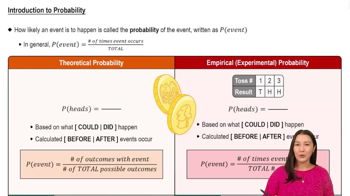
Probability is a measure of the likelihood of an event occurring, and it is always expressed as a number between 0 and 1. A probability of 0 indicates that an event will not occur, while a probability of 1 indicates certainty that the event will occur. Any number outside this range, such as 2.3, cannot represent a valid probability.
Recommended video:
5:37
Introduction to Probability

Interpretation of Probability

The interpretation of probability involves understanding it as a ratio of favorable outcomes to the total number of possible outcomes. For example, if an event has a probability of 0.5, it means there is an equal chance of the event occurring or not occurring. This interpretation helps clarify why values greater than 1 are not feasible.
Recommended video:
5:37
Introduction to Probability

Types of Events

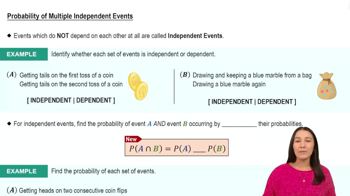
Events in probability can be classified as certain, impossible, or random. A certain event has a probability of 1, while an impossible event has a probability of 0. Understanding these classifications helps in determining whether a given number can represent a probability, as only numbers within the 0 to 1 range can correspond to valid events.
Recommended video:
05:54
Probability of Multiple Independent Events
Related Practice
Textbook Question

26. Eye Survey The table shows the results of a survey that asked 3203 people whether they wore contacts or glasses. A person is selected at random from the sample. Find the probability of each event.

d. The person is male or does not wear glasses.

" style="max-width: 100%; white-space-collapse: preserve;" width="480">

83
views
Textbook Question

Using the Multiplication Rule In Exercises 19-32, use the Multiplication Rule.

26. Worst President In a sample of 1500 adult U.S. citizens, 690 said that Donald Trump was the worst president in U.S. history. Three adult U.S. citizens are selected at random.

(Adapted from YouGov)

c. Find the probability that at most two of the three adult U.S. citizens say that Donald Trump was the worst president in U.S. history.

126
views
Textbook Question

22. Brexit A survey asked 1115 British adults how Britain's decision to leave the European Union has impacted the country. The results are shown in the Pareto chart. Find the

probability of each event. (Adapted from Ipsos)

d. Randomly selecting a British adult who feels that the move has had a fairly positive or very positive impact on Great Britain

77
views
Textbook Question

81. Genetics A Punnett square is a diagram that shows all possible gene combinations in a cross of parents whose genes are known. When two pink snapdragon flowers (RW) are crossed, there are four equally likely possible outcomes for the genetic makeup of the offspring: red (RR), pink (RW), pink (WR), and white (WW), as shown in the Punnett square at the left. When two pink snapdragons are crossed, what is the probability that the offspring will be (c) white?

130
views
Textbook Question

Politics The responses of 1500 U.S. adults to a survey that asked them to state their own political viewpoints are shown in the Pareto chart. Find the probability of each event.(Adapted from YouGov)

d. Randomly selecting a person from the sample who is either unsure or moderate


71
views
Textbook Question

Mental Health A survey asks 4805 parents the severity of the mental issues they experienced from the coronavirus pandemic. The results are shown in the table. A parent is randomly selected from the sample. Find the probability of each event. (Adapted from Kaiser Family Foundation)

" style="" width="345">

c. The parent did not have major mental health issues or is a mother.

104
views