Ch. 9 - Correlation and Regression
Larson - Elementary Statistics: Picturing the World 8th Edition
Larson8th EditionElementary Statistics: Picturing the WorldISBN: 9780137493470Not the one you use?Change textbook
Chapter 9, Problem 9.1.2

2. Describe the range of values for the correlation coefficient.

Verified step by step guidance
1
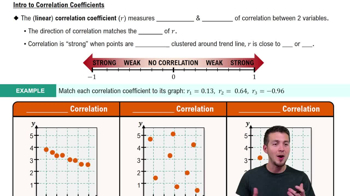
Understand that the correlation coefficient, often denoted as r, measures the strength and direction of the linear relationship between two variables.
Recognize that the correlation coefficient is a value that ranges between -1 and 1, inclusive.
Interpret the values: r = -1 indicates a perfect negative linear relationship, r = 1 indicates a perfect positive linear relationship, and r = 0 indicates no linear relationship.
Understand that values closer to -1 or 1 indicate stronger linear relationships, while values closer to 0 indicate weaker linear relationships.
Note that the correlation coefficient does not imply causation; it only quantifies the degree of linear association between two variables.

Verified video answer for a similar problem:

This video solution was recommended by our tutors as helpful for the problem above.
Video duration:
2m
Was this helpful?

Key Concepts

Here are the essential concepts you must grasp in order to answer the question correctly.

Correlation Coefficient

The correlation coefficient is a statistical measure that describes the strength and direction of a relationship between two variables. It is denoted by 'r' and can take values between -1 and 1. A value of 1 indicates a perfect positive correlation, -1 indicates a perfect negative correlation, and 0 indicates no correlation.
Recommended video:
Guided course
05:43
Correlation Coefficient

Range of Values

The range of values for the correlation coefficient is crucial for interpreting the degree of association between variables. Specifically, values closer to 1 or -1 signify a stronger relationship, while values near 0 suggest a weak or nonexistent relationship. Understanding this range helps in assessing the reliability of predictions based on the correlation.
Recommended video:
07:10
Empirical Rule of Standard Deviation and Range Rule of Thumb

Interpretation of Correlation

Interpreting the correlation coefficient involves understanding not just the strength but also the direction of the relationship. A positive correlation means that as one variable increases, the other tends to increase as well, while a negative correlation indicates that as one variable increases, the other tends to decrease. This interpretation is essential for making informed conclusions about the data.
Recommended video:
Guided course
05:43
Correlation Coefficient
Related Practice
Textbook Question

Graphical Analysis In Exercises 11–14, determine whether there is a perfect positive linear correlation, a strong positive linear correlation, a perfect negative linear correlation, a strong negative linear correlation, or no linear correlation between the variables.

65
views
Textbook Question

"Predicting y-Values In Exercises 3-6, use the multiple regression equation to predict the y-values for the values of the independent variables.

6. Elephant Weight The equation used to predict the weight of an elephant (in kilograms) is

y =- 4016+11.5x_1+7.55x_2+12.5x_3

where x_1 represents the girth of the elephant (in centimeters), x_2 represents the length of the elephant (in centimeters), and x_3 represents the circumference of a footpad (in

centimeters). (Source: Field Trip Earth)

a. x_1 = 421, x_2 = 224, x_3 = 144

b. x_1 = 311, x_2 = 171, x_3 = 102

c. x_1 = 376, x_2 = 226, x_3 = 124

d. x_1 =231, x_2 = 135, x_3 = 86"

36
views
Textbook Question

"Old Vehicles In Exercises 31–34, use the figure shown at the left.

33. Coefficient of Determination Find the coefficient of determination r^2 and interpret the results."

48
views
Textbook Question

6. Discuss the difference between r and p.

331
views
Textbook Question

5. To predict y-values using the equation of a regression line, what must be true about the correlation coefficient of the variables?

119
views
Textbook Question

"In Exercises 19-22, two variables are given that have been shown to have correlation but no cause-and-effect relationship. Describe at least one possible reason for the correlation.

22. Marriage rate in Kentucky and number of deaths caused by falling out of a fishing boat"

65
views