Ch. 9 - Correlation and Regression
Larson - Elementary Statistics: Picturing the World 8th Edition
Larson8th EditionElementary Statistics: Picturing the WorldISBN: 9780137493470Not the one you use?Change textbook
Chapter 9, Problem 9.1.22

"In Exercises 19-22, two variables are given that have been shown to have correlation but no cause-and-effect relationship. Describe at least one possible reason for the correlation.
22. Marriage rate in Kentucky and number of deaths caused by falling out of a fishing boat"

Verified step by step guidance
1
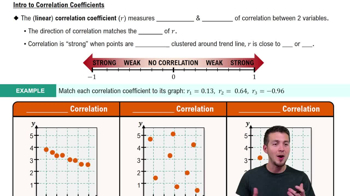
Understand the concept of correlation: Correlation measures the strength and direction of a linear relationship between two variables. However, correlation does not imply causation, meaning that just because two variables are correlated does not mean one causes the other.
Identify the two variables in the problem: The marriage rate in Kentucky and the number of deaths caused by falling out of a fishing boat. These variables are correlated but do not have a direct cause-and-effect relationship.
Consider external factors or confounding variables: There may be a third variable or set of variables influencing both the marriage rate and fishing boat deaths. For example, seasonal patterns could affect both variables—summer months might see higher marriage rates due to favorable weather and more fishing activity, which could lead to more accidents.
Think about population size and activity levels: Larger populations or regions with high levels of outdoor recreational activities might naturally have higher rates of both marriages and fishing-related deaths, creating a statistical correlation.
Reflect on statistical coincidence: Sometimes, correlations occur purely by chance or due to random patterns in the data. This could be an example of a spurious correlation where the relationship between the two variables is not meaningful or significant.

Verified video answer for a similar problem:

This video solution was recommended by our tutors as helpful for the problem above.
Video duration:
3m
Was this helpful?

Key Concepts

Here are the essential concepts you must grasp in order to answer the question correctly.

Correlation vs. Causation

Correlation refers to a statistical relationship between two variables, indicating that they tend to change together. However, this does not imply that one variable causes the other. Understanding this distinction is crucial, as it helps prevent misinterpretation of data, especially in cases where external factors may influence both variables.
Recommended video:
Guided course
05:43
Correlation Coefficient

Spurious Correlation

A spurious correlation occurs when two variables appear to be related but are actually influenced by a third variable or are coincidental. For example, the correlation between marriage rates and fishing boat accidents may be spurious, as both could be influenced by seasonal factors or demographic trends, rather than a direct causal link.
Recommended video:
Guided course
05:43
Correlation Coefficient

Confounding Variables

Confounding variables are external factors that can affect both variables in a study, leading to misleading conclusions about their relationship. Identifying these variables is essential for accurate analysis, as they can create the illusion of a correlation when, in fact, the relationship is driven by other influences.
Recommended video:
Guided course
07:09
Intro to Random Variables & Probability Distributions
Related Practice
Textbook Question

"In Exercises 7-12, match the description in the left column with its symbol(s) in the right column.

9. Slope

a. \(\hat{y}\)_i

b. y_i

c. b

d. (\(\bar{x}\), \(\bar{y}\))

e. m

f. \(\bar{y}\)"

51
views

Textbook Question

"Predicting y-Values In Exercises 3-6, use the multiple regression equation to predict the y-values for the values of the independent variables.

6. Elephant Weight The equation used to predict the weight of an elephant (in kilograms) is

y =- 4016+11.5x_1+7.55x_2+12.5x_3

where x_1 represents the girth of the elephant (in centimeters), x_2 represents the length of the elephant (in centimeters), and x_3 represents the circumference of a footpad (in

centimeters). (Source: Field Trip Earth)

a. x_1 = 421, x_2 = 224, x_3 = 144

b. x_1 = 311, x_2 = 171, x_3 = 102

c. x_1 = 376, x_2 = 226, x_3 = 124

d. x_1 =231, x_2 = 135, x_3 = 86"

36
views
Textbook Question

"Old Vehicles In Exercises 31–34, use the figure shown at the left.

33. Coefficient of Determination Find the coefficient of determination r^2 and interpret the results."

48
views
Textbook Question

5. To predict y-values using the equation of a regression line, what must be true about the correlation coefficient of the variables?

119
views
Textbook Question

2. Describe the range of values for the correlation coefficient.

248
views
Textbook Question

"In Exercises 7-12, match the description in the left column with its symbol(s) in the right column.

12. The point a regression line always passes through

a. \(\hat{y}\)_i

b. y_i

c. b

d. (\(\bar{x}\), \(\bar{y}\))

e. m

f. \(\bar{y}\)"

51
views