
Ch. 1 - Introduction to Statistics
Triola - Elementary Statistics 14th Edition
Triola14th EditionElementary StatisticsISBN: 9780137366446Not the one you use?Change textbook
Chapter 1, Problem 1.RE.7a

State Populations Currently, California has the largest population with 39,776,830 residents, and Wyoming has the smallest population with 573,520 residents.


a. Are the population sizes of the different states discrete or continuous?

Verified step by step guidance
1
Understand the difference between discrete and continuous data: Discrete data can only take specific values (often counts), while continuous data can take any value within a range.
Consider the nature of population data: Population counts are whole numbers, as you cannot have a fraction of a person.
Recognize that population sizes are counts of individuals, which are specific and separate values.
Conclude that since population sizes are counts of individuals, they are discrete data.
Remember that discrete data often involves counting distinct items, whereas continuous data involves measuring and can take any value within a range.

Verified video answer for a similar problem:

This video solution was recommended by our tutors as helpful for the problem above.
Video duration:
1m
Was this helpful?

Key Concepts

Here are the essential concepts you must grasp in order to answer the question correctly.

Discrete vs. Continuous Data

Discrete data refers to countable quantities, often represented by whole numbers, such as the number of people. Continuous data, on the other hand, can take any value within a range and is often measured, like height or temperature. Understanding whether data is discrete or continuous helps in choosing the appropriate statistical methods for analysis.
Recommended video:
Guided course
04:39
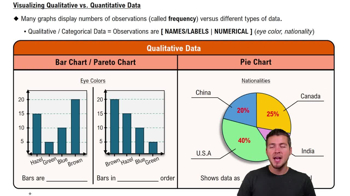
Visualizing Qualitative vs. Quantitative Data

Population Count

Population count is a discrete measure because it involves counting the number of individuals in a given area, such as a state. Each individual is a distinct unit, making the total population a whole number. This concept is crucial for understanding how population data is categorized and analyzed in statistics.
Recommended video:
04:04
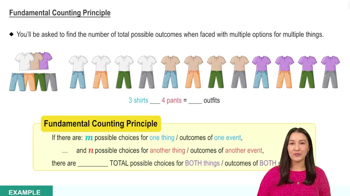
Fundamental Counting Principle

Statistical Data Types

Statistical data types are classifications that help in organizing and analyzing data. They include nominal, ordinal, interval, and ratio data. Population size is a ratio data type because it has a true zero point and allows for meaningful comparisons using multiplication and division, such as calculating population density or growth rates.
Recommended video:
Guided course
04:24
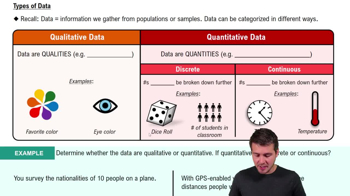
Types of Data
Related Practice
Textbook Question

Sampling For each of the following, identify the term that best describes the type of sample: systematic, convenience, stratified, cluster, or simple random sample.


d. A statistics student creates a survey and presents it to fellow statistics students.

254
views
Textbook Question

Paying for First Dates USA Today posted this question on the electronic version of its newspaper: “Should guys pay for the first date?” Of the 1148 subjects who decided to respond, 85% of them said “yes.”


c. Does the survey constitute an experiment or an observational study?

218
views
Textbook Question

Sampling For each of the following, identify the term that best describes the type of sample: systematic, convenience, stratified, cluster, or simple random sample.


a. As Lipitor pills are being manufactured, a quality control plan is to select every 500th pill and test it to confirm that it contains 80 mg of atorvastatin.

258
views
Textbook Question

Percentages

b. In a Pew Research Center poll on driving, 58% of the 1182 respondents said that they like to drive. What is the actual number of respondents who said that they like to drive?

316
views
Textbook Question

Percentages

a. The labels on U-Turn protein energy bars include the statement that these bars contain “125% less fat than the leading chocolate candy brands” (based on data from Consumer Reports magazine). What is wrong with that claim?

254
views
Textbook Question

State Populations Currently, California has the largest population with 39,776,830 residents, and Wyoming has the smallest population with 573,520 residents.


b. What is the level of measurement for the numbers of residents in the different states? (nominal, ordinal, interval, ratio)

265
views