
Ch. 3 - Probability
Larson - Elementary Statistics: Picturing the World 8th Edition
Larson8th EditionElementary Statistics: Picturing the WorldISBN: 9780137493470Not the one you use?Change textbook
Chapter 3, Problem 3.2.28a

"Using the Multiplication Rule In Exercises 19-32, use the Multiplication Rule.
28. Blood Types The probability that a Latinx American person in the United States has type A+ blood is 29%. Four Latinx American people in the United States are selected at random. (Source: American National Red Cross)
a. Find the probability that all four have type A+ blood."

Verified step by step guidance
1
Step 1: Understand the problem. We are tasked with finding the probability that all four Latinx American people selected at random have type A+ blood. This involves using the Multiplication Rule for independent events.
Step 2: Recall the Multiplication Rule. The rule states that if events are independent, the probability of all events occurring is the product of their individual probabilities. Mathematically, this can be expressed as: P(A \(\cap\) B \(\cap\) C \(\cap\) D) = P(A) \(\cdot\) P(B) \(\cdot\) P(C) \(\cdot\) P(D).
Step 3: Identify the probability of a single event. From the problem, the probability that one Latinx American person has type A+ blood is 29%, or P(A) = 0.29.
Step 4: Apply the Multiplication Rule. Since the selection of each person is independent, the probability that all four have type A+ blood is: P(A \(\cap\) B \(\cap\) C \(\cap\) D) = P(A) \(\cdot\) P(A) \(\cdot\) P(A) \(\cdot\) P(A) = (P(A))^4.
Step 5: Substitute the probability value into the formula. Replace P(A) with 0.29 to get: (0.29)^4. This is the probability that all four selected individuals have type A+ blood.

Verified video answer for a similar problem:

This video solution was recommended by our tutors as helpful for the problem above.
Video duration:
3m
Was this helpful?

Key Concepts

Here are the essential concepts you must grasp in order to answer the question correctly.

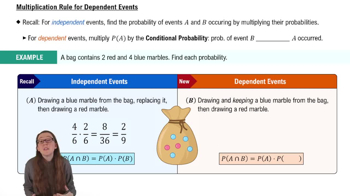
Multiplication Rule of Probability

The Multiplication Rule states that the probability of two or more independent events occurring together is the product of their individual probabilities. In this context, if the probability of one person having type A+ blood is 29%, the probability of four independent individuals all having type A+ blood is calculated by multiplying 0.29 by itself four times.
Recommended video:
05:17
Multiplication Rule: Dependent Events

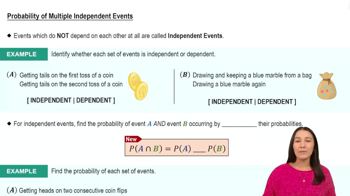
Independent Events

Independent events are those whose outcomes do not affect each other. In this scenario, the selection of one Latinx American person does not influence the blood type of another. This independence allows us to apply the Multiplication Rule effectively, as the probability remains constant across each selection.
Recommended video:
05:54
Probability of Multiple Independent Events

Probability Calculation

Probability is a measure of the likelihood of an event occurring, expressed as a number between 0 and 1. To find the probability that all four selected individuals have type A+ blood, we calculate it as (0.29)^4, which quantifies the chance of this specific outcome happening in a random selection of four people.
Recommended video:
Guided course
07:09
Probability From Given Z-Scores - TI-84 (CE) Calculator
Related Practice
Textbook Question

26. Eye Survey The table shows the results of a survey that asked 3203 people whether they wore contacts or glasses. A person is selected at random from the sample. Find the probability of each event.

a. The person wears only contacts or only glasses.

" style="" width="480">

91
views
Textbook Question

Shuffle Play You use a shuffle playback feature to randomly play songs in a playlist. The playlist of 56 songs includes 15 instrumental songs.

a. What is the probability that the first three songs to play are instrumental songs? (Assume a song cannot be repeated.)

95
views
Textbook Question

Using the Multiplication Rule In Exercises 19-32, use the Multiplication Rule.

24. Knowing a Person Who Was Murdered In a sample of 11,771 children ages 2 to 17, 8% have lost a friend or relative to murder. Four children are selected at random. (Adapted from University of New Hampshire)

a. Find the probability that all four have lost a friend or relative to murder.

112
views
Textbook Question

"Using the Multiplication Rule In Exercises 19-32, use the Multiplication Rule.

26. Worst President In a sample of 1500 adult U.S. citizens, 690 said that Donald Trump was the worst president in U.S. history. Three adult U.S. citizens are selected at random.

(Adapted from YouGov)

b. Find the probability that none of the three adult U.S. citizens say that Donald Trump was the worst president in U.S. history."

40
views
Textbook Question

Using the Multiplication Rule In Exercises 19-32, use the Multiplication Rule.

29. In Vitro Fertilization In a recent year, about 1.9% of all infants born in the U.S. were conceived through assisted reproductive technology (ART). Of the ART deliveries, about 26.4% resulted in multiple births. (Source: Morbidity and Mortality Weekly Report)

a. Find the probability that a randomly selected infant was conceived through ART and was part of a multiple birth.

88
views
Textbook Question

"Using the Multiplication Rule In Exercises 19-32, use the Multiplication Rule.

27. Blood Types The probability that a person of Asian descent in the United States has type O+ blood is 39%. At random, six people of Asian descent in the United States are selected. (Source: American National Red Cross)

a. Find the probability that all six have type O+ blood."

53
views