Ch. 7 - Hypothesis Testing with One Sample
Larson - Elementary Statistics: Picturing the World 8th Edition
Larson8th EditionElementary Statistics: Picturing the WorldISBN: 9780137493470Not the one you use?Change textbook
Chapter 7, Problem 7.RE.10a

In Exercises 7–10, state the null and alternative hypotheses and identify which represents the claim,


An energy bar maker claims that the mean number of grams of carbohydrates in one bar is less than 25.

Verified step by step guidance
1
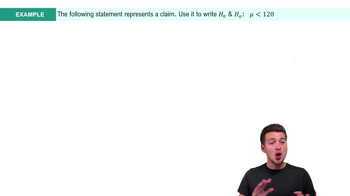
Identify the claim: The energy bar maker claims that the mean number of grams of carbohydrates in one bar is less than 25. This is the basis for the alternative hypothesis.
Define the null hypothesis (H₀): The null hypothesis always represents the statement of no effect or no difference. In this case, it would state that the mean number of grams of carbohydrates in one bar is greater than or equal to 25. Mathematically, H₀: μ ≥ 25.
Define the alternative hypothesis (H₁): The alternative hypothesis represents the claim being tested. Here, it states that the mean number of grams of carbohydrates in one bar is less than 25. Mathematically, H₁: μ < 25.
Determine which hypothesis represents the claim: Since the claim is that the mean is less than 25, the alternative hypothesis (H₁) represents the claim.
Summarize the hypotheses: Null hypothesis (H₀): μ ≥ 25. Alternative hypothesis (H₁): μ < 25. The claim is represented by the alternative hypothesis.

Verified video answer for a similar problem:

This video solution was recommended by our tutors as helpful for the problem above.
Video duration:
3m
Was this helpful?

Key Concepts

Here are the essential concepts you must grasp in order to answer the question correctly.

Null Hypothesis (H0)

The null hypothesis is a statement that indicates no effect or no difference, serving as a default position that there is no relationship between two measured phenomena. In this context, it would assert that the mean number of grams of carbohydrates in an energy bar is equal to or greater than 25 grams.
Recommended video:
Guided course
06:21
Step 1: Write Hypotheses

Alternative Hypothesis (H1)

The alternative hypothesis is a statement that contradicts the null hypothesis, suggesting that there is an effect or a difference. In this case, it posits that the mean number of grams of carbohydrates in an energy bar is less than 25 grams, which is the claim made by the energy bar maker.
Recommended video:
Guided course
06:21
Step 1: Write Hypotheses

Claim

A claim in hypothesis testing refers to a statement that is being tested for validity. In this scenario, the claim is that the mean carbohydrate content in the energy bars is less than 25 grams, which is represented by the alternative hypothesis, indicating the direction of the test.
Recommended video:
Guided course
01:35
Step 1: Write Hypotheses Example 1