Ch. 4 - Probability
Triola - Elementary Statistics 14th Edition
Triola14th EditionElementary StatisticsISBN: 9780137366446Not the one you use?Change textbook
Chapter 4, Problem 4.CRE.4a

Sampling Eye Color Based on a study by Dr. P. Sorita Soni at Indiana University, assume that eye colors in the United States are distributed as follows: 40% brown, 35% blue, 12% green, 7% gray, 6% hazel.


a. A statistics instructor collects eye color data from her students. What is the name for this type of sample?

Verified step by step guidance
1
Identify the type of sample being collected. In this scenario, the statistics instructor is collecting eye color data from her students.
Understand that the sample is not randomly selected from the entire population of the United States, but rather from a specific group (students in the instructor's class).
Recognize that this type of sample is known as a 'convenience sample'. A convenience sample is one where the sample is taken from a group that is easy to access or contact.
Consider the implications of using a convenience sample. It may not be representative of the entire population, as it is limited to a specific subset (students in the class).
Reflect on how the results from a convenience sample might differ from those obtained from a random sample of the entire population, potentially leading to biased or non-generalizable conclusions.

Verified video answer for a similar problem:

This video solution was recommended by our tutors as helpful for the problem above.
Video duration:
3m
Was this helpful?

Key Concepts

Here are the essential concepts you must grasp in order to answer the question correctly.

Sampling

Sampling is the process of selecting a subset of individuals from a population to estimate characteristics of the whole population. It is crucial in statistics to make inferences about a population without examining every individual. Different sampling methods can affect the accuracy and reliability of the results.
Recommended video:
05:11
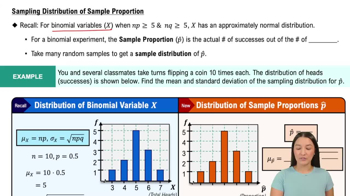
Sampling Distribution of Sample Proportion

Convenience Sampling

Convenience sampling is a non-probability sampling technique where samples are selected based on their easy availability and proximity to the researcher. This method is often used in educational settings, like collecting data from students, but it may not represent the broader population accurately due to potential biases.
Recommended video:
05:11
Sampling Distribution of Sample Proportion

Population Distribution

Population distribution refers to the way in which different characteristics, such as eye color, are spread across a population. Understanding the distribution helps in comparing sample data to the expected proportions in the population, which is essential for assessing representativeness and potential biases in sampling.
Recommended video:
04:48
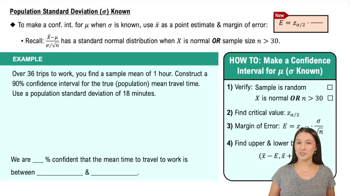
Population Standard Deviation Known
Related Practice
Textbook Question

In Exercises 1–10, use the data in the accompanying table and express all results in decimal form. (The data are from “The Left-Handed: Their Sinister History,” by Elaine Fowler Costas, Education Resources Information Center, Paper 399519.)


" style="" width="320">


Both Lefties If two of the study subjects are randomly selected with replacement, find the probability that they both write with their left hand.

141
views
Textbook Question

In Exercises 6–10, use the following results from tests of an experiment to test the effectiveness of an experimental vaccine for children (based on data from USA Today). Express all probabilities in decimal form.


Find the probability of randomly selecting 2 subjects without replacement and finding that they both developed flu.

166
views
Textbook Question

Cloud Seeding The “Florida Area Cumulus Experiment” was conducted by using silver iodide to seed clouds with the objective of increasing rainfall. For the purposes of this exercise, let the daily amounts of rainfall be represented by units of rnfl. (The actual rainfall amounts are in or )

Find the value of the following statistics and include appropriate units based on rnfl as the unit of measurement.

15.53 7.27 7.45 10.39 4.70 4.50 3.44 5.70 8.24 7.30 4.05 4.46


a. mean

b. median

98
views
Textbook Question

Heights of Presidents Theories have been developed about the heights of winning candidates for the U.S. presidency and the heights of candidates who were runners up. Listed below are heights (cm) from recent presidential elections. Construct a graph suitable for exploring an association between heights of presidents and the heights of the presidential candidates who were runners-up. What does the graph suggest about that association?

122
views
Textbook Question

Cloud Seeding The “Florida Area Cumulus Experiment” was conducted by using silver iodide to seed clouds with the objective of increasing rainfall. For the purposes of this exercise, let the daily amounts of rainfall be represented by units of rnfl. (The actual rainfall amounts are in or )

Find the value of the following statistics and include appropriate units based on rnfl as the unit of measurement.


[Image]


c. midrange

d. range

153
views
Textbook Question

In Exercises 1–10, use the data in the accompanying table and express all results in decimal form. (The data are from “The Left-Handed: Their Sinister History,” by Elaine Fowler Costas, Education Resources Information Center, Paper 399519.)


Lefty or Female Find the probability of randomly selecting one of the study subjects and getting someone who writes with their left hand or is a female.

149
views