
Textbook Question
True or False? In Exercises 5 and 6, determine whether the statement is true or false. If it is false, rewrite it as a true statement.
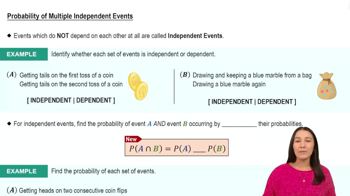
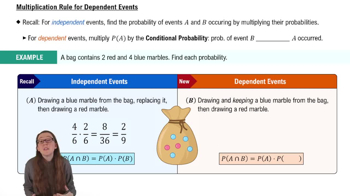
6. If events A and B are dependent, then P(A and B) = P(A) · P(B).
72
views

 Verified step by step guidance
 05:54
05:54
 05:17
05:17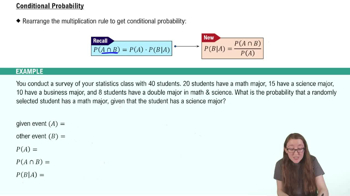 03:53
03:53True or False? In Exercises 5 and 6, determine whether the statement is true or false. If it is false, rewrite it as a true statement.
6. If events A and B are dependent, then P(A and B) = P(A) · P(B).
1. When you calculate the number of permutations of n distinct objects taken r at a time, what are you counting? Give an example.
"2. Give an example of
a. two events that are independent.
b. two events that are dependent."
13. Students A physics class has 40 students. Of these, 12 students are physics majors and 16 students are minoring in math. Of the physics majors, three are minoring in math. Find the probability that a randomly selected student is minoring in math or a physics major.
"Classifying Events Based on Studies In Exercises 15-18, identify the two events described in the study. Do the results indicate that the events are independent or dependent? Explain your reasoning.
15. A study was conducted to debunk the idea that abilities in music and math are related. Instead, the study showed a strong relationship between achievements in music and math.
(Source: University of Kansas)"
16. Can Defects Of the cans produced by a company, 96% do not have a puncture, 93% do not have a smashed edge, and 89.3% have neither a puncture nor a smashed edge. Find
the probability that a randomly selected can does not have a puncture or a smashed edge.