Ch. 10 - Correlation and Regression
Triola - Elementary Statistics 14th Edition
Triola14th EditionElementary StatisticsISBN: 9780137366446Not the one you use?Change textbook
Chapter 10, Problem 10.1.1b

Notation The author conducted an experiment in which the height of each student was measured in centimeters and those heights were matched with the same students’ scores on the first statistics test.
b. Without doing any research or calculations, estimate the value of r.

Verified step by step guidance
1
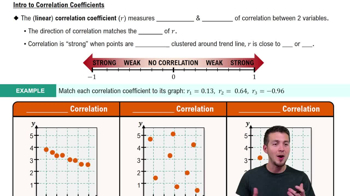
Understand the concept of correlation coefficient (r): It measures the strength and direction of a linear relationship between two variables. The value of r ranges from -1 to 1.
Consider the context: The problem involves matching students' heights with their scores on a statistics test. Think about whether you expect a positive, negative, or no correlation between these two variables.
Reflect on possible relationships: If taller students tend to score higher, you might expect a positive correlation. If there is no apparent relationship, the correlation might be close to zero.
Estimate the correlation: Based on your understanding of the context and the possible relationship, make an educated guess about the value of r. For example, if you think there is a slight positive relationship, you might estimate r to be around 0.2 or 0.3.
Consider variability: Remember that correlation does not imply causation, and other factors could influence the scores. Your estimate should reflect the potential variability and uncertainty in the relationship.

Verified video answer for a similar problem:

This video solution was recommended by our tutors as helpful for the problem above.
Video duration:
3m
Was this helpful?

Key Concepts

Here are the essential concepts you must grasp in order to answer the question correctly.

Correlation Coefficient (r)

The correlation coefficient, denoted as 'r', measures the strength and direction of a linear relationship between two variables. It ranges from -1 to 1, where values close to 1 indicate a strong positive correlation, values close to -1 indicate a strong negative correlation, and values around 0 suggest no linear correlation.
Recommended video:
Guided course
05:43
Correlation Coefficient

Scatter Plot

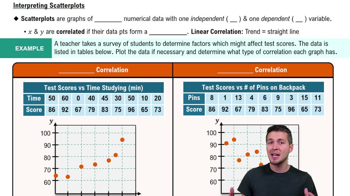
A scatter plot is a graphical representation of the relationship between two quantitative variables. Each point on the plot represents an individual data point, with one variable on the x-axis and the other on the y-axis. Analyzing the pattern of points can help estimate the correlation coefficient by visually assessing the strength and direction of the relationship.
Recommended video:
Guided course
05:43
Correlation Coefficient

Linear Relationship

A linear relationship between two variables implies that as one variable changes, the other variable tends to change in a consistent manner, either increasing or decreasing. This relationship can be represented by a straight line on a graph, and the correlation coefficient 'r' quantifies how closely the data points fit this line.
Recommended video:
Guided course
06:36
Scatterplots & Intro to Correlation
Related Practice
Textbook Question

Effects of Clusters Refer to the Minitab-generated scatterplot given in Exercise 10 of Section 10-1.


a. Using the pairs of values for all 8 points, find the equation of the regression line.

173
views

Textbook Question

Notation The author conducted an experiment in which the height of each student was measured in centimeters and those heights were matched with the same students’ scores on the first statistics test.

c. Does r change if the heights are converted from centimeters to inches?

253
views
Textbook Question

Least-Squares Property According to the least-squares property, the regression line minimizes the sum of the squares of the residuals. Refer to the jackpot/tickets data in Table 10-1 and use the regression equation y^ = -10.9 + 0.174x that was found in Examples 1 and 2 of this section.

b. Find the sum of the squares of the residuals.

302
views
Textbook Question

Clusters Refer to the Minitab-generated scatterplot. The four points in the lower left corner are measurements from women, and the four points in the upper right corner are from men.

a. Examine the pattern of the four points in the lower left corner (from women) only, and subjectively determine whether there appears to be a correlation between x and y for women.

146
views
Textbook Question

Variation and Prediction Intervals

In Exercises 17–20, find the (a) explained variation, (b) unexplained variation, and (c) indicated prediction interval. In each case, there is sufficient evidence to support a claim of a linear correlation, so it is reasonable to use the regression equation when making predictions.

Altitude and Temperature Listed below are altitudes (thousands of feet) and outside air temperatures (°F) recorded by the author during Delta Flight 1053 from New Orleans to Atlanta. For the prediction interval, use a 95% confidence level with the altitude of 6327 ft (or 6.327 thousand feet).

85
views
Textbook Question

Outlier Refer to the accompanying Minitab-generated scatterplot.

b. After identifying the 10 pairs of coordinates corresponding to the 10 points, find the value of the correlation coefficient r and determine whether there is a linear correlation.

134
views