Skip to main content
Introductory Statistics
My Course
Learn
Exam Prep
AI Tutor
Study Guides
Textbook Solutions
Flashcards
Explore
Try the app
My Course
Learn
Exam Prep
AI Tutor
Study Guides
Textbook Solutions
Flashcards
Explore
Try the app
Back
Basic Concepts of Probability quiz #3
You can tap to flip the card.
What are four ways of showing probability?
You can tap to flip the card.
👆
What are four ways of showing probability?
As a fraction, decimal, percentage, or ratio.
Track progress
Control buttons has been changed to "navigation" mode.
1/40
Related flashcards
Related practice
Recommended videos
Basic Concepts of Probability quiz #1
Basic Concepts of Probability
40 Terms
Basic Concepts of Probability quiz #2
Basic Concepts of Probability
40 Terms
Basic Concepts of Probability quiz #4
Basic Concepts of Probability
39 Terms
Basic Concepts of Probability
4. Probability
7 problems
Topic
Ernest
Complements
4. Probability
4 problems
Topic
Ernest
4. Probability - Part 1 of 3
3 topics
9 problems
Chapter
Ernest
4. Probability - Part 2 of 3
4 topics
12 problems
Chapter
Ernest
4. Probability - Part 3 of 3
2 topics
6 problems
Chapter
Ally
Guided course
5:37
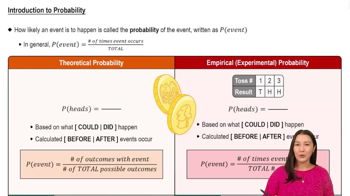
Introduction to Probability
11155
views
435
rank
1
comments
Terms in this set (40)
Hide definitions
What are four ways of showing probability?
As a fraction, decimal, percentage, or ratio.
Which theoretical probabilities are equal to 1/3?
Any event with one favorable outcome out of three equally likely outcomes.
How many simple random samples of size 3 can be selected from a population of size 7?
The number is given by the combination formula: 7 choose 3 = 35.
What is an example of a simple random sample?
Selecting names from a hat where each name has an equal chance of being chosen.
Does a probability distribution function always have a mathematical formula with parameters?
Not always; some distributions are defined by tables or lists.
How do you calculate the probability that a player will toss a die at least two times before a specific outcome occurs?
Use the geometric probability formula for the number of trials until the first success.
What type of data are best captured by statistical methods?
Quantitative data.
What is joint relative frequency?
It is the proportion of cases that fall into both categories of two variables.
What is a compound event in probability?
A compound event consists of two or more simple events.
What illustrates the definition of a probability distribution?
A list or function assigning probabilities to all possible outcomes.
What is not a property of the t distribution?
It is not always symmetric for small sample sizes.
What is an assumption in p chart calculation?
The sample size should be large enough for the normal approximation to be valid.
Which research question would not be tested using inferential statistics?
A question about a known population parameter.
How do you calculate the probability that someone will answer at least half the questions correctly?
Sum the probabilities for all outcomes where the number of correct answers is at least half.
What must be known about a data set before using the empirical rule?
The data must be approximately normally distributed.
If a racehorse wins 5 of its first 7 races, what is the ratio of races won to races lost?
5:2.
What is the first step in conducting a scientific poll?
Define the target population.
What is the chance of landing on an odd number on two spins of a spinner with odd and even numbers?
Multiply the probability of landing on an odd number for each spin.
How do you calculate the percent of time an event occurs?
Divide the number of times the event occurs by the total number of trials and multiply by 100.
What is the sample space of a normal 6-sided die?
The sample space is {1, 2, 3, 4, 5, 6}.
How do you calculate the probability that a spinner lands on a red section?
Divide the number of red sections by the total number of sections.
What are the two requirements for a discrete probability distribution?
Probabilities must be between 0 and 1, and their sum must be 1.
What are the criteria for a binomial probability experiment?
Fixed number of trials, two possible outcomes, independent trials, and constant probability of success.
What is the difference between an outcome and an event?
An outcome is a single result; an event is a set of outcomes.
How do you determine if a value is a parameter or a statistic?
A parameter describes a population; a statistic describes a sample.
What is not a voluntary response sample?
A sample selected randomly from a population.
What is the difference between univariate and bivariate data?
Univariate data involve one variable; bivariate data involve two variables.
What is not a characteristic of the t test?
It does not require the data to be normally distributed for large samples.
What is the difference between a census and sampling?
A census collects data from the entire population; sampling collects data from a subset.
What must be known about a data set before using the empirical rule?
The data should be approximately normally distributed.
In which type of statistical study is the population influenced by researchers?
An experimental study.
How would you describe a probability distribution?
It assigns probabilities to all possible outcomes of a random experiment.
What is an assumption when using a nonparametric test?
The data do not need to follow a specific distribution.
What best represents an empirical probability?
Probability calculated from observed data.
True or false: For a continuous random variable, f(x) must always lie between 0 and 1.
False; for continuous variables, f(x) can be greater than 1, but the total area under the curve is 1.
What are examples of inferential statistics?
Estimating population parameters from sample data, hypothesis testing.
What is required for interpreting data?
Data must be valid and reliable.
What are examples of secondary data sources?
Data collected by someone else, such as published reports or databases.
When is it appropriate to use the geometric distribution?
When modeling the number of trials until the first success in repeated independent Bernoulli trials.
How do you calculate the probability that a florist randomly selects a tulip for a bouquet?
Divide the number of tulips by the total number of flowers.
 BackBack

 5:37
5:37