How do scientists use probability when describing risks?
They quantify the likelihood of events to assess and communicate risk.
What is true of covariance?
Covariance measures the direction of the linear relationship between two variables.
When would you calculate an expected value?
When you want to find the average outcome of a random variable over many trials.
For p(a or b) = p(a) + p(b), what must be true?
Events a and b must be mutually exclusive.
What is true of statistical forecasting methods that capture historic trends?
They use past data to predict future outcomes.
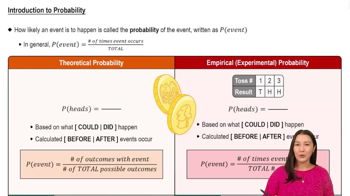
What is a proper way to describe the probability of flipping heads on a fair coin?
The probability is 1/2, or 0.5, or 50%.
What limits the accuracy of a poll?
Sampling error.
How is the addition rule of probability best described?
The probability of either event a or b is the sum of their probabilities minus the probability of both occurring.
What does it mean for data to have a relationship with the answer needed?
The data are relevant to the research question.
What are primary data?
Primary data are collected directly by the researcher for a specific purpose.
What are the two requirements for a discrete probability distribution?
Probabilities must be between 0 and 1, and their sum must be 1.
What is the difference between an outcome and an event?
An outcome is a single result; an event is a set of outcomes.
How do you determine if a value is a parameter or a statistic?
A parameter describes a population; a statistic describes a sample.
What is the difference between univariate and bivariate data?
Univariate data involve one variable; bivariate data involve two variables.
What is meant by a marginal distribution and a conditional distribution?
Marginal distribution is the distribution of one variable; conditional distribution is the distribution of one variable given a specific value of another.
Which numbers cannot be used to represent the probability of an event?
Numbers less than 0 or greater than 1.
How do you determine whether a number is a statistic or a parameter?
If it describes a sample, it is a statistic; if it describes a population, it is a parameter.
What are primary data?
Primary data are collected firsthand by the researcher.
If the data collected are the number of traffic tickets, what is the level of measurement?
Ratio level.
What are the two requirements for a discrete probability distribution?
Probabilities must be between 0 and 1, and their sum must be 1.
What is the difference between relative frequency and cumulative frequency?
Relative frequency is the proportion of times an event occurs; cumulative frequency is the sum of frequencies up to a certain point.
What is not a requirement of the binomial probability distribution?
More than two possible outcomes per trial.
How is a sample related to a population?
A sample is a subset of a population.
What are properties of the student's t-distribution?
It is symmetric, bell-shaped, and has heavier tails than the normal distribution.
What is meant by a marginal distribution and a conditional distribution?
Marginal distribution is the distribution of one variable; conditional distribution is the distribution given a condition on another variable.
What is the difference between an outcome and an event?
An outcome is a single result; an event is a set of outcomes.
How do you determine if a value is a parameter or a statistic?
A parameter describes a population; a statistic describes a sample.
What is not a voluntary response sample?
A sample selected randomly from the population.
What is the difference between univariate and bivariate data?
Univariate data involve one variable; bivariate data involve two variables.
What is not a level of measurement?
Probability is not a level of measurement.
What must be known about a data set before using the empirical rule?
The data should be approximately normally distributed.
Why is it important to be skeptical of statistical results reported in the media?
Media reports may misrepresent data or omit important context.
Is valid data always reliable data?
Not necessarily; data can be valid but not reliable, and vice versa.
How is error (accuracy of a poll) expressed?
As a plus-or-minus percentage.
What is the Monte Carlo fallacy?
The mistaken belief that past random events affect future outcomes.
Why is a sample used more often than a population?
Because sampling is more practical and efficient.
What is the benefit of using inferential statistics?
It allows researchers to make conclusions about populations from samples.
What is the process of finding patterns and anomalies in data to predict outcomes called?
 Back
Back

 5:37
5:37