Skip to main content
Introductory Statistics
My Course
Learn
Exam Prep
AI Tutor
Study Guides
Textbook Solutions
Flashcards
Explore
Try the app
My Course
Learn
Exam Prep
AI Tutor
Study Guides
Textbook Solutions
Flashcards
Explore
Try the app
Back
Binomial Distribution definitions
You can tap to flip the card.
Binomial Experiment
You can tap to flip the card.
👆
Binomial Experiment
A process with two possible outcomes per trial, repeated a fixed number of times, where each trial is independent.
Track progress
Control buttons has been changed to "navigation" mode.
1/15
Related flashcards
Related practice
Recommended videos
Binomial Distribution quiz #1
Binomial Distribution
25 Terms
Binomial Distribution
5. Binomial Distribution & Discrete Random Variables
7 problems
Topic
Ernest
5. Binomial Distribution & Discrete Random Variables
4 topics
12 problems
Chapter
Ernest
Guided course
03:33
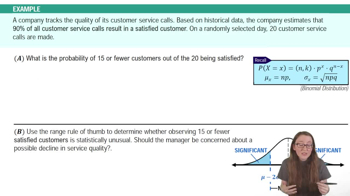
Finding Binomial Probabilities Using TI-84 Example 1
1447
views
18
rank
Guided course
04:20
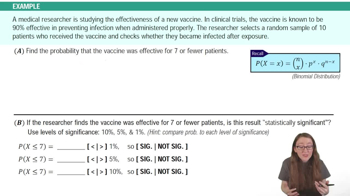
Finding Binomial Probabilities Using TI-84 Example 2
1112
views
28
rank
Guided course
03:28
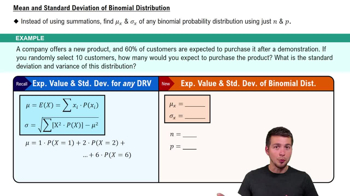
Mean & Standard Deviation of Binomial Distribution
3205
views
56
rank
Terms in this set (15)
Hide definitions
Binomial Experiment
A process with two possible outcomes per trial, repeated a fixed number of times, where each trial is independent.
Success
A desired outcome in a binomial experiment, such as landing heads in a coin flip or pulling a red marble.
Failure
The alternative outcome to success in a binomial experiment, like tails in a coin flip or pulling a blue marble.
Trial
A single repetition of a binomial experiment, such as one coin flip or one marble draw.
Probability of Success
The likelihood of achieving the desired outcome in a single trial, denoted by p.
Probability of Failure
The likelihood of not achieving the desired outcome in a single trial, calculated as 1 minus p and denoted by q.
Discrete Random Variable
A variable representing countable outcomes, such as the number of successes in a binomial experiment.
Number of Trials
The total count of independent repetitions in a binomial experiment, denoted by n.
Expected Value
The average number of successes anticipated in a binomial experiment, found by multiplying n and p.
Standard Deviation
A measure of variability in the number of successes, calculated as the square root of n times p times q.
Variance
The squared value of the standard deviation, representing the spread of possible outcomes in a binomial experiment.
Complement
The probability of the opposite event, used to simplify calculations for ranges of outcomes.
Combination
A count of possible ways to arrange a specific number of successes among trials, often written as n choose x.
Binomial Probability Formula
An equation combining combinations, probabilities of success and failure, to find the chance of a specific number of successes.
Cumulative Probability
The total probability of achieving up to a certain number of successes, often calculated using binom CDF.
 BackBack
 03:33
03:33