Skip to main content
Introductory Statistics
My Course
Learn
Exam Prep
AI Tutor
Study Guides
Textbook Solutions
Flashcards
Explore
Try the app
My Course
Learn
Exam Prep
AI Tutor
Study Guides
Textbook Solutions
Flashcards
Explore
Try the app
Back
Complements definitions
You can tap to flip the card.
Complement
You can tap to flip the card.
👆
Complement
All possible outcomes where a specific event does not occur, forming a set opposite to the event within the sample space.
Track progress
Control buttons has been changed to "navigation" mode.
1/15
Related flashcards
Related practice
Recommended videos
Complements quiz
Complements
15 Terms
Complements
4. Probability
4 problems
Topic
Ernest
Addition Rule
4. Probability
6 problems
Topic
Ernest
4. Probability - Part 1 of 3
3 topics
9 problems
Chapter
Ernest
4. Probability - Part 2 of 3
4 topics
12 problems
Chapter
Ernest
4. Probability - Part 3 of 3
2 topics
6 problems
Chapter
Ally
Guided course
4:23
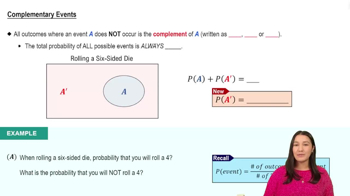
Complementary Events
7282
views
222
rank
Terms in this set (15)
Hide definitions
Complement
All possible outcomes where a specific event does not occur, forming a set opposite to the event within the sample space.
Event
A specific outcome or group of outcomes of a random experiment, such as rolling a particular number on a die.
Probability
A numerical measure representing the likelihood of an event, calculated as favorable outcomes divided by total possible outcomes.
Sample Space
The complete set of all possible outcomes for a random experiment, such as all sides of a die.
Notation
Symbols or marks used to represent events and their complements, including apostrophes, bars, or special signs.
Formula
A mathematical expression used to calculate probabilities, such as subtracting an event's probability from one for its complement.
Classical Probability
A principle stating that the sum of probabilities for all possible outcomes equals one, ensuring completeness.
Outcome
A single possible result from a random experiment, like drawing a specific card or rolling a certain number.
Deck
A collection of 52 cards used in probability examples, each card representing a unique outcome.
Queen
A specific card in a deck, often used as an example event in probability calculations.
Decimal
A numerical representation of probability, such as 0.92, used for easier interpretation of results.
Total Outcomes
The count of all possible results in an experiment, forming the denominator in probability calculations.
Favorable Outcomes
The number of results that satisfy the event of interest, forming the numerator in probability calculations.
Non-occurrence
The situation where a specific event does not happen, represented by its complement in probability.
Random Experiment
A process with uncertain results, such as rolling dice or drawing cards, forming the basis for probability analysis.
 BackBack

 4:23
4:23