Back

Correlation Coefficient definitions

Control buttons has been changed to "navigation" mode.
1/15
  • Correlation Coefficient

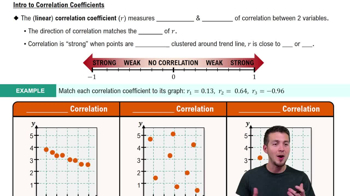
    A numerical value between -1 and 1 that quantifies the relationship's direction and strength between two variables.
  • Linear Correlation Coefficient

    A specific measure, denoted by r, that assesses how closely data points cluster around a straight trend line.
  • Direction

    Indicates whether the relationship between variables trends upward (positive) or downward (negative) based on the sign of r.
  • Strength

    Reflects how tightly data points cluster around a trend line; values near ±1 show strong relationships, values near 0 show weak ones.
  • Positive Correlation

    A relationship where increases in one variable are associated with increases in another, represented by positive r values.
  • Negative Correlation

    A relationship where increases in one variable are associated with decreases in another, represented by negative r values.
  • Scatterplot

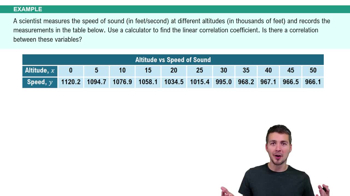
    A graphical display of paired data points used to visually assess trends and relationships between two variables.
  • Trend Line

    A straight line drawn through data points on a scatterplot to indicate the general direction of the relationship.
  • No Correlation

    A situation where data points are widely scattered, and r is close to zero, indicating no discernible relationship.
  • TI-84

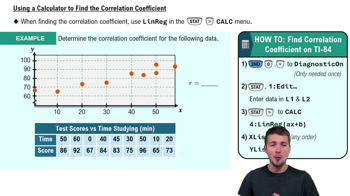
    A graphing calculator commonly used to input data and compute statistical measures such as the correlation coefficient.
  • Stat Menu

    A calculator feature that allows access to statistical functions, including data entry and calculation of regression statistics.
  • LinReg

    A calculator function for linear regression analysis, providing values like r and r squared from input data.
  • Diagnostic On

    A calculator setting that enables display of statistical values, including r, during regression calculations.
  • R Squared

    A value shown in regression output that represents the proportion of variance explained, distinct from r but related.
  • Best Fit Line

    A line that most closely represents the overall trend in a scatterplot, used to assess correlation visually.