Correlation Coefficient quiz #3 Flashcards

Correlation Coefficient quiz #3
Control buttons has been changed to "navigation" mode.
1/40
  • Which r-value is most likely for a dataset with a strong positive linear relationship: -0.872, -0.191, 0.191, or 0.872?
    0.872 is most likely for a strong positive linear relationship.
  • What best describes a statistical relationship indicated by a high correlation coefficient?
    A strong association between the two variables.
  • Which relationship would most likely have the weakest correlation?
    A relationship where the variables do not show a consistent pattern or trend.
  • Which statement is true of correlation analysis?
    Correlation analysis measures the strength and direction of linear association between variables.
  • What is used to evaluate how well the sample regression equation fits the data?
    The coefficient of determination (r²) is used.
  • What is the best description of a positive association between two variables?
    As one variable increases, the other variable tends to increase.
  • Which test gives the same result as a test of the regression line slope?
    A test of the correlation coefficient r gives the same result.
  • Correlation means all of the following except that ________.
    Correlation does not mean causation.
  • What are the properties of the linear correlation coefficient?
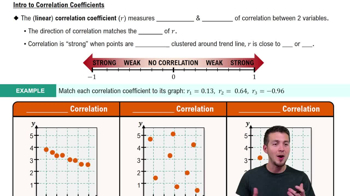
    r ranges from -1 to 1, is unitless, and measures strength and direction of linear association.
  • Which statement about correlation is true?
    Correlation measures linear association but does not imply causation.
  • Which is not a property of the linear correlation coefficient r?
    r does not measure non-linear relationships.
  • Correlation means that ________.
    There is an association between two variables.
  • If two variables are not related at all, what is their likely correlation coefficient?
    Their correlation coefficient is likely close to 0.
  • A correlation indicates that there is _____ between two variables.
    An association.
  • What are the properties of the linear correlation coefficient?
    r ranges from -1 to 1, is unitless, and measures strength and direction of linear association.
  • Which statement about correlation is true?
    Correlation measures association, not causation.
  • What does it mean to say that two variables are positively associated?
    As one variable increases, the other tends to increase.
  • What are the properties of the linear correlation coefficient?
    r ranges from -1 to 1, is unitless, and measures strength and direction of linear association.
  • Which statement about correlation is true?
    Correlation measures the strength and direction of a linear relationship.
  • What are the properties of the linear correlation coefficient?
    r ranges from -1 to 1, is unitless, and measures strength and direction of linear association.
  • Which is not one of the three common errors involving correlation?
    Assuming correlation implies causation is a common error.
  • What does a correlation coefficient tell you?
    It tells you the strength and direction of the linear relationship between two variables.
  • What does a negative correlation mean?
    As one variable increases, the other variable tends to decrease.
  • What are explanatory and response variables in correlation analysis?
    The explanatory variable is the independent variable; the response variable is the dependent variable.
  • Is it possible to have a positive correlation between tests that measure different things?
    Yes, if the scores tend to increase together, there can be a positive correlation.
  • What does it mean if there is a linear correlation between data?
    It means the data points tend to follow a straight-line pattern.
  • What is the most likely correlation coefficient for a dataset with a strong positive linear relationship?
    The correlation coefficient is most likely close to 1.
  • Which correlation coefficient represents the strongest relationship?
    The r-value closest to ±1 represents the strongest relationship.
  • What is an advantage of the correlation coefficient over covariance?
    The correlation coefficient is unitless and allows comparison across different datasets.
  • Which method can be used to show a cause-and-effect relationship between two variables?
    Experimental studies can show cause-and-effect, not correlation analysis.
  • What is the most likely correlation coefficient between a stock-index mutual fund and the S&P 500?
    It is likely close to 1, indicating a strong positive correlation.
  • Which scatterplot shows the strongest relation?
    The scatterplot with data points tightly clustered around a straight line shows the strongest relation.
  • If you find a correlational relationship between two variables, what does this mean?
    It means there is an association, but not necessarily causation.
  • True or false: Correlation implies causation.
    False. Correlation does not imply causation.
  • How do you determine which plot shows the strongest linear correlation?
    The plot with data points most tightly clustered around a straight line shows the strongest linear correlation.
  • Based on a scatterplot, how do you select the most likely value of the linear correlation coefficient r?
    Estimate r based on how tightly the points cluster around a line and the direction of the trend.
  • If height and weight are positively correlated, what does this mean?
    As height increases, weight tends to increase.
  • What is the purpose of correlation analysis?
    To determine the strength and direction of the linear relationship between two variables.
  • What is the range of values for the correlation coefficient?
    The correlation coefficient ranges from -1 to 1.
  • If r² = 1 in regression and correlation analysis, what does this mean?
    It means the model explains 100% of the variance; the fit is perfect.