Skip to main content
Introductory Statistics
My Course
Learn
Exam Prep
AI Tutor
Study Guides
Textbook Solutions
Flashcards
Explore
Try the app
My Course
Learn
Exam Prep
AI Tutor
Study Guides
Textbook Solutions
Flashcards
Explore
Try the app
Back
Determining the Minimum Sample Size Required definitions
You can tap to flip the card.
Confidence Interval
You can tap to flip the card.
👆
Confidence Interval
A range constructed around a sample mean to estimate a population mean with a specified probability.
Track progress
Control buttons has been changed to "navigation" mode.
1/15
Related flashcards
Related practice
Recommended videos
Determining the Minimum Sample Size Required quiz
Determining the Minimum Sample Size Required
15 Terms
Determining the Minimum Sample Size Required
7. Sampling Distributions & Confidence Intervals: Mean
5 problems
Topic
Zachary
7. Sampling Distributions & Confidence Intervals: Mean
4 topics
12 problems
Chapter
Ally
Guided course
06:51
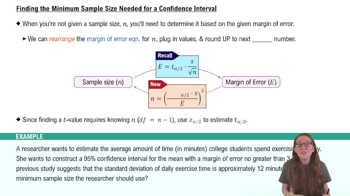
Determining the Minimum Sample Size Required
959
views
8
rank
Terms in this set (15)
Hide definitions
Confidence Interval
A range constructed around a sample mean to estimate a population mean with a specified probability.
Margin of Error
The maximum amount by which a sample estimate may differ from the true population value in a confidence interval.
Sample Size
The number of subjects or observations included in a study, affecting the precision of statistical estimates.
Critical Value
A number from statistical tables used to determine the boundaries of a confidence interval for a given confidence level.
Standard Deviation
A measure of variability indicating how spread out values are in a dataset, often estimated from prior studies.
Degrees of Freedom
A value calculated as one less than the sample size, used in statistical formulas for estimating variability.
Confidence Level
The probability that a confidence interval contains the true population parameter, commonly expressed as a percentage.
Range Rule of Thumb
A method for estimating standard deviation by dividing the difference between maximum and minimum values by four.
Population Mean
The average value of a variable for all members of a population, estimated using sample data.
Z-Value
A standardized score from the normal distribution used to calculate confidence intervals when sample size is large.
T-Value
A score from the t-distribution used in confidence interval calculations, especially when sample size is small.
Prior Information
Data or estimates from previous studies used to inform calculations when current sample statistics are unavailable.
Estimation
The process of inferring population parameters based on sample statistics and probability models.
Decimal Rounding
The practice of increasing a calculated sample size to the next whole number to ensure statistical requirements are met.
Maximum Margin of Error
The largest allowable difference between a sample estimate and the population parameter for a confidence interval.
 BackBack

 06:51
06:51