Skip to main content
Introductory Statistics
My Course
Learn
Exam Prep
AI Tutor
Study Guides
Textbook Solutions
Flashcards
Explore
Try the app
My Course
Learn
Exam Prep
AI Tutor
Study Guides
Textbook Solutions
Flashcards
Explore
Try the app
Back
Determining the Minimum Sample Size Required quiz
You can tap to flip the card.
What is the purpose of determining the minimum sample size in confidence interval estimation?
You can tap to flip the card.
👆
What is the purpose of determining the minimum sample size in confidence interval estimation?
To ensure the margin of error does not exceed a specified maximum, supporting accurate confidence interval estimation.
Track progress
Control buttons has been changed to "navigation" mode.
1/15
Related flashcards
Related practice
Recommended videos
Determining the Minimum Sample Size Required definitions
Determining the Minimum Sample Size Required
15 Terms
Determining the Minimum Sample Size Required
7. Sampling Distributions & Confidence Intervals: Mean
5 problems
Topic
Zachary
7. Sampling Distributions & Confidence Intervals: Mean
4 topics
12 problems
Chapter
Ally
Guided course
06:51
Determining the Minimum Sample Size Required
959
views
8
rank
Terms in this set (15)
Hide definitions
What is the purpose of determining the minimum sample size in confidence interval estimation?
To ensure the margin of error does not exceed a specified maximum, supporting accurate confidence interval estimation.
How does increasing the sample size n affect the margin of error e?
As the sample size n increases, the margin of error e decreases.
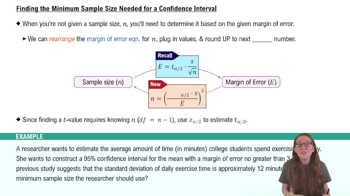
What formula is used to calculate the minimum sample size n for a desired margin of error e?
n = (zα/2 × s / e)^2, where zα/2 is the critical z-value, s is the estimated standard deviation, and e is the margin of error.
Why do we always round up when calculating the minimum sample size?
We round up to ensure the sample size is large enough so the margin of error does not exceed the maximum allowed.
What value do we use for the critical value when the sample size is unknown: t or z?
We use the critical z-value (zα/2) because the t-value requires knowing the sample size, which we are solving for.
How do you estimate the standard deviation if it is not provided?
Use the range rule of thumb: estimate the standard deviation as the range divided by four.
What is the range rule of thumb for estimating standard deviation?
It is the maximum value minus the minimum value, divided by four.
If you calculate a minimum sample size of 61.47, what sample size should you use?
You should use 62, always rounding up to the next whole number.
Why can't you use the t-distribution critical value when solving for minimum sample size?
Because the t-distribution requires degrees of freedom, which depend on the sample size n that we are trying to find.
What is the critical z-value for a 95% confidence level?
The critical z-value for a 95% confidence level is 1.96.
What information do you need to calculate the minimum sample size?
You need the desired confidence level, the estimated standard deviation, and the maximum allowed margin of error.
What does the margin of error represent in a confidence interval?
It represents how far the confidence interval extends on either side of the sample mean.
If prior information about standard deviation is not available, what should you do?
Estimate the standard deviation using the range rule of thumb.
Why is it important to not round down the calculated sample size?
Rounding down could result in a margin of error that is too large, exceeding the maximum allowed.
What is the relationship between the sample size and the width of the confidence interval?
A larger sample size results in a narrower confidence interval, due to a smaller margin of error.
 BackBack

 06:51
06:51