Back

Discrete Random Variables definitions

Control buttons has been changed to "navigation" mode.
1/15
  • Random Variable

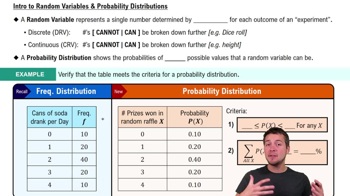
    A symbol representing a value determined by chance for each outcome in an experiment.
  • Discrete Random Variable

    A variable with distinct, indivisible outcomes, such as whole numbers from a dice roll.
  • Continuous Random Variable

    A variable with outcomes that can be broken down infinitely, covering all values within a range.
  • Probability Distribution

    A table showing all possible values of a random variable and their associated probabilities.
  • Frequency Distribution

    A summary listing outcomes and their observed frequencies after an experiment.
  • Outcome

    A possible result from an experiment, represented as a value of a random variable.
  • Probability

    A decimal between 0 and 1 indicating the likelihood of a specific outcome occurring.
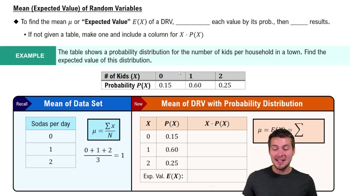
  • Expected Value

    A weighted average of all possible values, calculated using each value's probability.
  • Mean

    A central value of a probability distribution, found by summing products of values and probabilities.
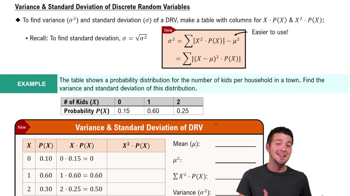
  • Variance

    A measure of how spread out outcomes are, calculated by subtracting the mean squared from the sum of squared values times probabilities.
  • Standard Deviation

    A value indicating the typical distance outcomes deviate from the mean, found by taking the square root of variance.
  • Sigma Notation

    A mathematical symbol used to represent the sum of a series of terms, often in probability calculations.
  • Table

    An organized arrangement of outcomes and probabilities, aiding calculation and visualization.
  • Experiment

    A process or action resulting in random outcomes, forming the basis for probability analysis.
  • Criteria

    Conditions required for a probability distribution, such as probabilities summing to one and each being between zero and one.