Skip to main content
Introductory Statistics
My Course
Learn
Exam Prep
AI Tutor
Study Guides
Textbook Solutions
Flashcards
Explore
Try the app
My Course
Learn
Exam Prep
AI Tutor
Study Guides
Textbook Solutions
Flashcards
Explore
Try the app
Back
Intro to Collecting Data definitions
4 students found this helpful
You can tap to flip the card.
Population
You can tap to flip the card.
👆
Population
Entire group of individuals or items under study, from which data may be collected or conclusions drawn.
Track progress
Control buttons has been changed to "navigation" mode.
1/15
Related flashcards
Related practice
Recommended videos
Intro to Collecting Data quiz #1
Intro to Collecting Data
6 Terms
Intro to Collecting Data
1. Intro to Stats and Collecting Data
5 problems
Topic
Brendan
Sampling Methods
1. Intro to Stats and Collecting Data
5 problems
Topic
Ally
1. Intro to Stats and Collecting Data
4 topics
12 problems
Chapter
Brendan
Guided course
4:01
Introduction to Collecting Data
10921
views
407
rank
4
comments
Terms in this set (15)
Hide definitions
Population
Entire group of individuals or items under study, from which data may be collected or conclusions drawn.
Sample
Subset of a population selected for analysis, used to make inferences about the whole group.
Parameter
Numerical value summarizing a characteristic of a population, often unknown and estimated from data.
Statistic
Numerical value summarizing a characteristic of a sample, used to estimate population parameters.
Sampling Frame
List or representation of all elements in a population from which a sample is drawn.
Random Sampling
Method ensuring each member of a population has an equal chance of selection, reducing bias.
Bias
Systematic error in data collection or analysis that distorts results and affects validity.
Survey
Structured method for gathering information from individuals, often using questionnaires.
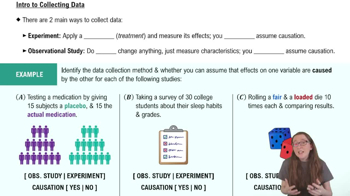
Observational Study
Research approach where data is collected without intervention, allowing natural behaviors to be recorded.
Experiment
Controlled study involving manipulation of variables to determine causal relationships.
Variable
Characteristic or attribute that can take on different values among individuals or items.
Data
Recorded values or measurements collected for analysis, forming the basis of statistical study.
Nonresponse
Situation where selected individuals do not participate, potentially affecting representativeness.
Sampling Error
Difference between sample results and population values due to random selection.
Census
Collection of data from every member of a population, providing complete information.
 BackBack
 4:01
4:01