Back

Pie Charts definitions

1 student found this helpful
Control buttons has been changed to "navigation" mode.
1/14
  • Pie Chart

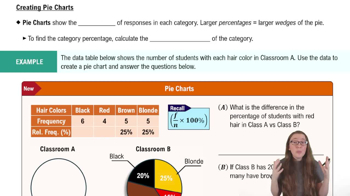
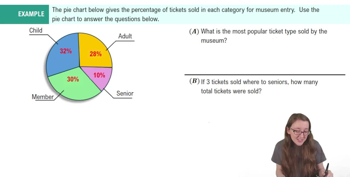
    A circular graph divided into wedges, each representing a category's percentage of the total responses.
  • Wedge

    A section of a circle in a pie chart, sized according to the percentage of a specific category.
  • Category

    A distinct group or type within qualitative data, each shown as a separate wedge in a pie chart.
  • Percentage

    A value expressing a category's proportion of the total, calculated by multiplying relative frequency by 100.
  • Frequency

    The count of responses or occurrences for a specific category within a dataset.
  • Relative Frequency

    A category's frequency divided by the total number of responses, often converted to a percentage.
  • Total Responses

    The sum of all category frequencies, representing the overall number of data points in a dataset.
  • Data Table

    A structured arrangement of categories and their frequencies, used to prepare pie chart calculations.
  • Visual Representation

    A graphical display, such as a pie chart, that helps interpret and compare categorical data.
  • Qualitative Data

    Information grouped by categories rather than numerical values, often visualized with pie charts.
  • Difference

    The gap between two category percentages, often measured in percentage points for comparison.
  • Label

    A text or marker identifying the category and percentage for each wedge in a pie chart.
  • Decimal

    A numerical form used to convert percentages for calculations, such as finding a category's count.
  • Percentage Point

    A unit for measuring the difference between two percentages, distinct from absolute frequency.