Standard Deviation quiz #3 Flashcards

Standard Deviation quiz #3
Control buttons has been changed to "navigation" mode.
1/40
  • Which weights are within 2 standard deviations of the mean?
    Weights within the interval [mean - 2s, mean + 2s] are within 2 standard deviations of the mean.
  • Which statement is true about standard deviation?
    Standard deviation uses all data values and is sensitive to outliers.
  • If the sample variance of hourly wages is 10, what is the sample standard deviation?
    Sample standard deviation is sqrt(10).
  • What effect does removing an outlier have on the standard deviation?
    Removing an outlier typically decreases the standard deviation.
  • Of what is standard deviation a direct measure?
    Standard deviation directly measures the spread or variability of data values.
  • How do you calculate the variance of a data set such as 0.0625, 0.25, 0.5, 1.5?
    Find the mean, subtract it from each value, square the differences, sum them, and divide by (n-1).
  • Why is the range less desirable than the standard deviation as a measure of dispersion?
    Range only considers the extremes, while standard deviation uses all data values.
  • What can be said about a set of data with a standard deviation of 0?
    All values are identical; there is no spread.
  • What happens to the graph of the normal curve as the mean increases?
    The curve shifts to the right, but its shape remains unchanged.
  • Which is not a property of the standard deviation?
    Standard deviation cannot be negative.
  • How can you tell which histogram depicts a higher standard deviation?
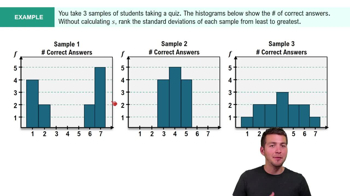
    The histogram with more spread out data has a higher standard deviation.
  • Why is the standard deviation used more frequently than the variance?
    Standard deviation is in the same units as the data, making it easier to interpret.
  • If the standard deviation for a set of data is 0, what does this indicate?
    All data values are identical; there is no spread.
  • Given the mean of a normal distribution, what does the standard deviation indicate?
    Standard deviation indicates how spread out the values are around the mean.
  • What proportion of data is within one standard deviation of the mean in a normal distribution?
    Approximately 68% of data is within one standard deviation of the mean.
  • Which group of scores would have the smallest standard deviation?
    The group with values closest to each other (least spread) has the smallest standard deviation.
  • Why is the standard deviation preferable to the range as a measure of variation?
    Standard deviation uses all data values and reflects overall variability, while range only uses extremes.
  • Which characteristic does not describe a normal distribution?
    A normal distribution is not skewed; it is symmetric.
  • How can the standard deviation be used to specify uncertainty?
    Standard deviation quantifies the typical deviation from the mean, indicating uncertainty in measurements.
  • When is an observation considered an outlier?
    An observation is considered an outlier if it is more than 2 or 3 standard deviations from the mean.
  • What is the range rule of thumb for estimating the standard deviation?
    Standard deviation ≈ range / 4.
  • What does the z-score represent in statistics?
    The z-score represents the number of standard deviations an observation is from the mean.
  • For a bell-shaped data set, approximately what proportion of data falls within two standard deviations of the mean?
    Approximately 95% of data falls within two standard deviations of the mean.
  • What is the range rule of thumb for estimating the standard deviation of a data set?
    Standard deviation ≈ range / 4.
  • What can be said about a set of data with a standard deviation of 0?
    All values are identical; there is no spread.
  • What happens to the graph of the normal curve as the mean increases?
    The curve shifts to the right, but its shape remains unchanged.
  • Which is not a property of the standard deviation?
    Standard deviation cannot be negative.
  • How can you tell which histogram depicts a higher standard deviation?
    The histogram with more spread out data has a higher standard deviation.
  • Why is the standard deviation used more frequently than the variance?
    Standard deviation is in the same units as the data, making it easier to interpret.
  • If the standard deviation for a set of data is 0, what does this indicate?
    All data values are identical; there is no spread.
  • Which characteristic of data measures the amount that the data values vary?
    Standard deviation measures the amount that data values vary.
  • What must be known about a data set before the empirical rule can be used?
    The data set must be approximately normally distributed.
  • Why is the standard deviation preferable to the range as a measure of variation?
    Standard deviation uses all data values and reflects overall variability.
  • Is standard deviation a resistant measure of spread?
    No, standard deviation is not resistant; it is sensitive to outliers.
  • What describes the usefulness of a standard deviation?
    Standard deviation quantifies variability and helps compare the spread of different data sets.
  • Which set of data will have the smallest standard deviation?
    The set with values closest to each other (least spread) will have the smallest standard deviation.
  • Approximately what percent of people score lower than three standard deviations below the mean?
    Approximately 0.15% of people score lower than three standard deviations below the mean in a normal distribution.
  • Which symbol identifies the sample standard deviation?
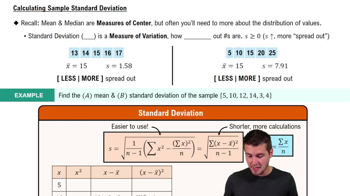
    The symbol s identifies the sample standard deviation.
  • What can be said about a set of data with a standard deviation of 0?
    All values are identical; there is no spread.
  • Which is not a property of the standard deviation?
    Standard deviation cannot be negative.