Statistics
My Course
Learn
Exam Prep
AI Tutor
Study Guides
Textbook Solutions
Flashcards
Explore
My Course
Learn
Exam Prep
AI Tutor
Study Guides
Textbook Solutions
Flashcards
Explore
Back
Standard Deviation quiz #4
You can tap to flip the card.
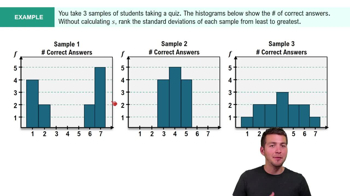
How can you tell which histogram depicts a higher standard deviation?
You can tap to
flip the card.
👆
How can you tell which histogram depicts a higher standard deviation?
The histogram with more spread out data has a higher standard deviation.
Track progress
Control buttons has been changed to "navigation" mode.
1/40
Related flashcards
Related practice
Recommended videos
Guided course
08:45
Calculating Standard Deviation
Patrick
4448
views
68
rank
Guided course
02:59
Calculating Standard Deviation Example 1
Patrick
1744
views
69
rank
1
comments
Terms in this set (40)
Hide definitions
How can you tell which histogram depicts a higher standard deviation?
The histogram with more spread out data has a higher standard deviation.
What can be said about a set of data with a standard deviation of 0?
All values are identical; there is no spread.
What happens to the graph of the normal curve as the mean increases?
The curve shifts to the right, but its shape remains unchanged.
Which is not a property of the standard deviation?
Standard deviation cannot be negative.
What can be said about a set of data with a standard deviation of 0?
All values are identical; there is no spread.
What happens to the graph of the normal curve as the mean increases?
The curve shifts to the right, but its shape remains unchanged.
Which is not a property of the standard deviation?
Standard deviation cannot be negative.
How can you tell which histogram depicts a higher standard deviation?
The histogram with more spread out data has a higher standard deviation.
If the standard deviation for a set of data is 0, what does this indicate?
All data values are identical; there is no spread.
Which characteristic of data measures the amount that the data values vary?
Standard deviation measures the amount that data values vary.
What proportion of data is within one standard deviation of the mean in a normal distribution?
Approximately 68% of data is within one standard deviation of the mean.
Which deviation is the square root of the variance in a set of numerical data?
Standard deviation is the square root of the variance.
How does increasing the standard deviation affect the normal curve?
Larger standard deviation results in a wider and flatter normal curve.
Is the standard deviation resistant to outliers?
No, standard deviation is sensitive to outliers.
How can you tell which histogram depicts a higher standard deviation?
The histogram with more spread out data has a higher standard deviation.
What is the unit for population variance?
Population variance is in squared units of the original data.
How do you calculate the variance of the sample data 2, 6, 2, 10?
Find the mean, subtract it from each value, square the differences, sum them, and divide by (n-1).
What is variance and what is standard deviation, rounded to the nearest whole number?
Variance is the average squared deviation from the mean; standard deviation is its positive square root, rounded as needed.
How do you calculate the variance of the sample data 8, 6, 2, 8?
Find the mean, subtract it from each value, square the differences, sum them, and divide by (n-1).
How do you calculate the variance of the population data 2, 0, 1, 9?
Find the mean, subtract it from each value, square the differences, sum them, and divide by N.
If an observation has a z-score of 0, what does this mean?
The observation is equal to the mean.
How do you calculate the standard deviation of the sample data 2, 6, 2, 0, 5?
Find the mean, subtract it from each value, square the differences, sum them, divide by (n-1), and take the square root.
How do you calculate the standard deviation of the population data 3, 1, 2, 9, 5?
Find the mean, subtract it from each value, square the differences, sum them, divide by N, and take the square root.
In a normal distribution, which is greater, the mean or the median?
In a normal distribution, the mean and median are equal.
What is the standard deviation of the distribution of sample means?
The standard deviation of the distribution of sample means is called the standard error.
Can the variance ever be negative?
No, variance is always zero or positive.
Can standard deviation be negative?
No, standard deviation is always zero or positive.
What is the numerical value that the standard deviation can never be?
Standard deviation can never be negative.
Which data set has the smallest standard deviation?
The data set with values closest to each other (least spread) has the smallest standard deviation.
What is the unit for population standard deviation?
Population standard deviation is in the same units as the original data.
Standard deviation measures which type of risk?
Standard deviation measures total risk or variability in data.
The standard deviation is used in conjunction with which other statistic to describe data?
Standard deviation is used with the mean to describe the distribution of data.
What is the square of the standard deviation called in statistics?
The square of the standard deviation is called the variance.
Can the standard deviation of a data set be negative?
No, the standard deviation cannot be negative; it is always greater than or equal to zero.
What is the relationship between variance and standard deviation?
Standard deviation is the square root of the variance, and variance is the square of the standard deviation.
What symbol is commonly used to represent standard deviation in statistics?
The symbol 's' is commonly used for sample standard deviation; for population standard deviation, the Greek letter sigma (σ) is used.
What does the standard deviation measure in a data set?
Standard deviation measures the variability or spread of data values around the mean.
How are variance and standard deviation mathematically related?
Variance is the square of the standard deviation, and standard deviation is the square root of the variance.
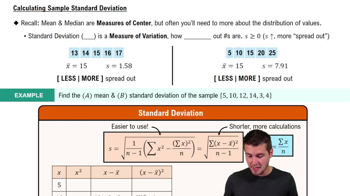
Is standard deviation considered a measure of center or a measure of variation?
Standard deviation is a measure of variation, not a measure of center.
What is the general formula for calculating variance in a sample?
The formula for sample variance is s² = [Σx² - (Σx)²/n] / (n - 1), where n is the sample size.