Statistics
My Course
Learn
Exam Prep
AI Tutor
Study Guides
Textbook Solutions
Flashcards
Explore
My Course
Learn
Exam Prep
AI Tutor
Study Guides
Textbook Solutions
Flashcards
Explore
Back
Steps in Hypothesis Testing definitions
You can tap to flip the card.
Define:
Null Hypothesis
You can tap to flip the card.
👆
Null Hypothesis
A default claim about a population parameter, always written with an equal sign and used as the basis for comparison in hypothesis testing.
Track progress
Control buttons has been changed to "navigation" mode.
1/15
Related flashcards
Related practice
Recommended videos
Steps in Hypothesis Testing quiz #1
Steps in Hypothesis Testing
37 Terms
Steps in Hypothesis Testing quiz #2
Steps in Hypothesis Testing
38 Terms
Steps in Hypothesis Testing quiz #3
Steps in Hypothesis Testing
14 Terms
Steps in Hypothesis Testing
9. Hypothesis Testing for One Sample
7 problems
Topic

Ally
9. Hypothesis Testing for One Sample
1 topic
3 problems
Chapter
David-Paige
Guided course
05:12
Intro to Hypothesis Testing
Patrick
670
views
9
rank
Guided course
06:21
Step 1: Write Hypotheses
Patrick
3165
views
81
rank
2
comments
Guided course
01:35
Step 1: Write Hypotheses Example 1
Patrick
1606
views
55
rank
1
comments
Terms in this set (15)
Hide definitions
Null Hypothesis
A default claim about a population parameter, always written with an equal sign and used as the basis for comparison in hypothesis testing.
Alternative Hypothesis
An opposing claim to the default assumption, expressed with less than, greater than, or not equal symbols, representing what evidence is sought.
Population
The entire group under study, about which claims are made and tested using sample data.
Sample
A subset of the population, used to collect data and infer characteristics about the larger group.
Parameter
A numerical value describing a characteristic of the population, such as mean, proportion, or standard deviation.
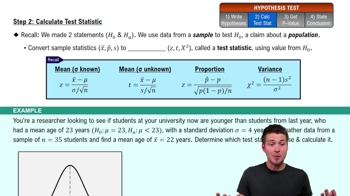
Test Statistic
A calculated value, often a z or t score, quantifying how different the sample data is from the claimed population parameter.
Z Score
A standardized value indicating how many standard deviations a sample statistic is from the assumed population mean.
T Score
A standardized value used when the population standard deviation is unknown, measuring sample deviation from the mean.
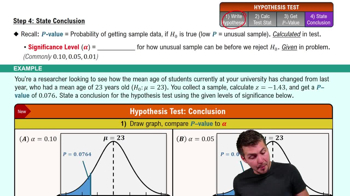
P Value
A probability representing how likely the observed sample data is, assuming the default claim about the population is true.
Significance Level
A threshold, commonly 0.05, used to determine how unusual a sample must be before rejecting the default claim.
Critical Region
The area in a distribution where, if the p value falls within, the default claim is rejected due to the sample being too unusual.
Left-Tailed Test
A hypothesis test where the alternative claim uses a less than symbol, and the p value is the area to the left of the test statistic.
Right-Tailed Test
A hypothesis test where the alternative claim uses a greater than symbol, and the p value is the area to the right of the test statistic.
Two-Tailed Test
A hypothesis test where the alternative claim uses a not equal symbol, and the p value covers both extremes of the distribution.
Sample Mean
The average value calculated from the sample, used to compare against the population mean in hypothesis testing.