Steps in Hypothesis Testing quiz #3 Flashcards

Steps in Hypothesis Testing quiz #3
Control buttons has been changed to "navigation" mode.
1/10
  • What are the two possible decisions you can make from performing a hypothesis test?
    You can either reject the null hypothesis or fail to reject the null hypothesis.
  • The t-test is principally a test of what?
    The t-test is principally a test of the population mean when the population standard deviation is unknown.
  • In a hypothesis test, if the computed p-value is less than 0.001, what does this indicate?
    If the p-value is less than 0.001, there is very strong evidence to reject the null hypothesis.
  • What is not true for a hypothesis test for correlation?
    It is not true that the null hypothesis for correlation uses a 'not equal to' sign; it typically states that the correlation coefficient equals zero.
  • When testing the difference of means for paired data, what is the null hypothesis?
    The null hypothesis for paired data is that the mean difference between pairs is zero.
  • What is the null hypothesis when using ANOVA procedures?
    The null hypothesis in ANOVA is that all group means are equal.
  • If the null hypothesis is rejected in hypothesis testing, what does this mean?
    If the null hypothesis is rejected, it means there is enough evidence to support the alternative hypothesis.
  • In hypothesis testing, if the null hypothesis is rejected, what is the implication?
    Rejecting the null hypothesis implies that the sample data provides sufficient evidence against the null hypothesis in favor of the alternative.
  • When the p-value is used for hypothesis testing, when is the null hypothesis rejected?
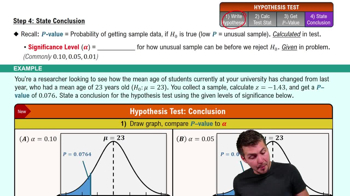
    The null hypothesis is rejected if the p-value is less than the significance level (alpha).
  • What are the main steps in conducting a hypothesis test?
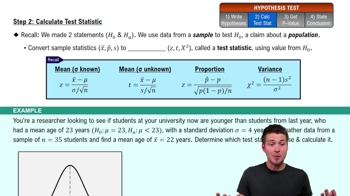
    The main steps are: state the hypotheses, calculate the test statistic, find the p-value, compare p-value to alpha, and make a conclusion.