Skip to main content
Introductory Statistics
My Course
Learn
Exam Prep
AI Tutor
Study Guides
Textbook Solutions
Flashcards
Explore
Try the app
My Course
Learn
Exam Prep
AI Tutor
Study Guides
Textbook Solutions
Flashcards
Explore
Try the app
Back
Two Means - Matched Pairs (Dependent Samples) definitions
You can tap to flip the card.
Matched Pairs
You can tap to flip the card.
👆
Matched Pairs
Samples uniquely related, often through before-and-after comparisons, with each value paired in a one-to-one relationship.
Track progress
Control buttons has been changed to "navigation" mode.
1/15
Related flashcards
Related practice
Recommended videos
Two Means - Matched Pairs (Dependent Samples) quiz #1
Two Means - Matched Pairs (Dependent Samples)
10 Terms
Two Means - Matched Pairs (Dependent Samples)
10. Hypothesis Testing for Two Samples
3 problems
Topic
Brendan
10. Hypothesis Testing for Two Samples - Part 1 of 2
5 topics
12 problems
Chapter
Brendan
10. Hypothesis Testing for Two Samples - Part 2 of 2
1 topic
2 problems
Chapter
Ernest
Guided course
07:23
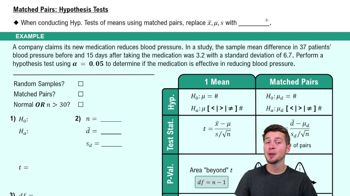
Matched Pairs: Hypothesis Tests
622
views
5
rank
Guided course
07:19
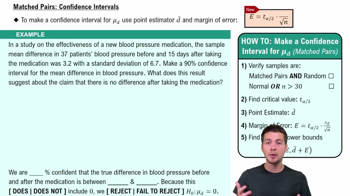
Matched Pairs: Confidence Intervals
619
views
1
rank
Guided course
08:33
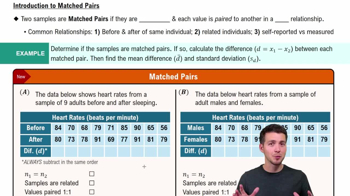
Introduction to Matched Pairs
851
views
14
rank
Terms in this set (15)
Hide definitions
Matched Pairs
Samples uniquely related, often through before-and-after comparisons, with each value paired in a one-to-one relationship.
Dependent Samples
Groups where values are linked, such as repeated measures on the same individuals, affecting each other's outcomes.
Mean Difference
Average of the differences calculated between paired values, serving as the point estimator in analysis.
Standard Deviation of the Difference
Measure of variability among the differences in matched pairs, used in margin of error calculations.
Null Hypothesis
Default assumption stating no difference exists between paired values, often set to zero in matched pairs tests.
Alternative Hypothesis
Statement suggesting a significant change or difference between paired values, guiding the direction of the test.
Confidence Interval
Range constructed around the mean difference, indicating where the true population difference likely falls.
Margin of Error
Amount added and subtracted from the mean difference, calculated using the critical t-value and standard deviation.
Critical t-value
Threshold from the t-distribution, determined by confidence level and degrees of freedom, used in interval and error calculations.
Degrees of Freedom
Value found by subtracting one from the number of pairs, influencing the shape of the t-distribution.
Point Estimator
Best guess for the population mean difference, typically the sample mean difference in matched pairs analysis.
One-to-One Relationship
Direct pairing of values from two samples, ensuring each value is uniquely matched for comparison.
Random Sample
Selection process ensuring each individual has an equal chance of inclusion, supporting valid statistical inference.
p-value
Probability of observing results as extreme as those found, given the null hypothesis is true, used for decision-making.
Level of Significance
Threshold for deciding whether to reject the null hypothesis, commonly set at 0.05 in hypothesis testing.
 BackBack

 07:23
07:23