Ch. 1 - Introduction to Statistics
Larson - Elementary Statistics: Picturing the World 8th Edition
Larson8th EditionElementary Statistics: Picturing the WorldISBN: 9780137493470Not the one you use?Change textbook
Chapter 1, Problem 1.1.14

Determine whether the data set is a population or a sample. Explain your reasoning.
The annual revenue of each team in a pro sports league

Verified step by step guidance
1
Understand the definitions: A population refers to the entire group of individuals or items that you are studying, while a sample is a subset of the population selected for analysis.
Identify the context of the problem: The data set provided includes the annual revenue of each team in a pro sports league. This suggests that the data includes all teams in the league, not just a subset.
Evaluate whether the data set represents the entire group: Since the problem specifies 'each team,' it implies that the data set includes all teams in the league, making it a population.
Explain the reasoning: The data set is a population because it includes all members of the group being studied (all teams in the league). If only a few teams were included, it would be considered a sample.
Conclude: Based on the information provided, the data set represents a population, as it encompasses the entire group of interest (all teams in the league).

Verified video answer for a similar problem:

This video solution was recommended by our tutors as helpful for the problem above.
Video duration:
1m
Was this helpful?

Key Concepts

Here are the essential concepts you must grasp in order to answer the question correctly.

Population

A population refers to the entire group of individuals or items that share a common characteristic. In statistics, it encompasses all possible observations that can be made. For example, if we consider the annual revenue of every team in a pro sports league, this group represents the complete population since it includes all teams without exception.
Recommended video:
04:48
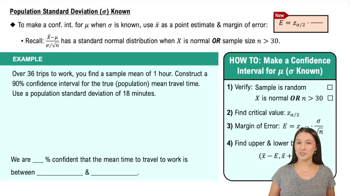
Population Standard Deviation Known

Sample

A sample is a subset of a population, selected to represent the larger group. It is used in statistical analysis to draw conclusions about the population without needing to collect data from every member. If we were to analyze the annual revenue of only a few selected teams rather than all teams in the league, that would constitute a sample.
Recommended video:
05:11
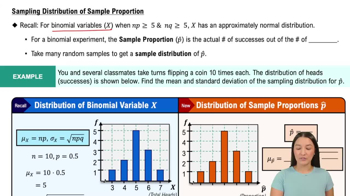
Sampling Distribution of Sample Proportion

Data Collection Context

Understanding the context of data collection is crucial in determining whether a data set is a population or a sample. In this case, since the question specifies 'the annual revenue of each team in a pro sports league,' it indicates that all teams are included, thus confirming that the data set is a population rather than a sample.
Recommended video:
Guided course
04:39
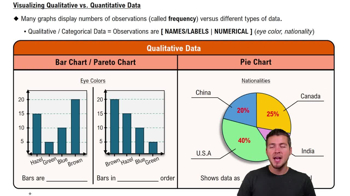
Visualizing Qualitative vs. Quantitative Data
Related Practice
Textbook Question

Determine whether the data set is a population or a sample. Explain your reasoning.

The amount spent by every tenth person cashing out at a store

220
views
Textbook Question

A study showed the same level of T cell production in senior citizens who are amateur cyclists as in young adults, but a significantly lower level of T cell production in senior citizens who do not exercise regularly. Is it appropriate to infer that exercise stimulates T cell production? Explain. (Source: University of Birmingham)

125
views
Textbook Question

Determine whether the survey question is biased. If the question is biased, suggest a better wording.

How does the media influence the opinions of voters?

156
views
Textbook Question

Determine whether the study is an observational study or an experiment. Explain.

A research study compared the memory retention of subjects when a learning activity was followed by a brief period of wakeful rest and when a learning activity was followed by a brief period of distraction. (Source: Springer Nature)

233
views
Textbook Question

Volunteers for an experiment are numbered from 1 to 90. The volunteers are to be randomly assigned to two different treatment groups. Use a random number generator different from the one you used in Exercise 21 to choose 45 subjects for the treatment group. The other 45 subjects will go into the control group. List the subjects, according to number, in each group. Tell which method you used to generate the random numbers.

73
views
Textbook Question

Determine whether the statement is true or false. If it is false, rewrite it as a true statement.

The method for selecting a stratified sample is to order a population in some way and then select members of the population at regular intervals.

203
views