Ch. 3 - Probability
Larson - Elementary Statistics: Picturing the World 8th Edition
Larson8th EditionElementary Statistics: Picturing the WorldISBN: 9780137493470Not the one you use?Change textbook
Chapter 3, Problem 3.1.66a

66. Access Code An access code consists of six characters. For each character, any letter or number can be used, with the exceptions that the first character cannot be 0 and the last two characters must be odd numbers.
a. What is the probability of randomly selecting the correct access code on the first try?

Verified step by step guidance
1
Step 1: Determine the total number of possible characters for each position in the access code. There are 36 possible characters (26 letters + 10 digits) for most positions, except for the first and last two positions which have specific restrictions.
Step 2: For the first character, it cannot be '0', so there are 35 possible choices (26 letters + 9 digits excluding '0').
Step 3: For the last two characters, they must be odd numbers. There are 5 odd digits (1, 3, 5, 7, 9), so each of these two positions has 5 possible choices.
Step 4: For the remaining three middle characters, there are no restrictions, so each of these positions has 36 possible choices.
Step 5: Calculate the total number of possible access codes by multiplying the number of choices for each position: (35 choices for the first character) × (36 choices for the second character) × (36 choices for the third character) × (36 choices for the fourth character) × (5 choices for the fifth character) × (5 choices for the sixth character). Then, calculate the probability of randomly selecting the correct access code on the first try by taking the reciprocal of this total number of possible access codes.

Verified video answer for a similar problem:

This video solution was recommended by our tutors as helpful for the problem above.
Video duration:
6m
Was this helpful?

Key Concepts

Here are the essential concepts you must grasp in order to answer the question correctly.

Combinatorics

Combinatorics is a branch of mathematics dealing with counting, arrangement, and combination of objects. In this context, it helps determine the total number of possible access codes by considering the restrictions on character selection, such as the first character not being '0' and the last two characters being odd numbers.

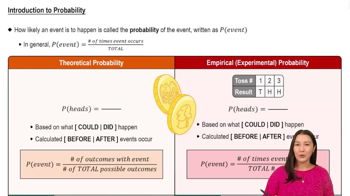
Probability

Probability is a measure of the likelihood that an event will occur, expressed as a ratio of favorable outcomes to the total number of possible outcomes. To find the probability of selecting the correct access code on the first try, one must calculate the ratio of successful outcomes (1 correct code) to the total number of valid access codes.
Recommended video:
5:37
Introduction to Probability

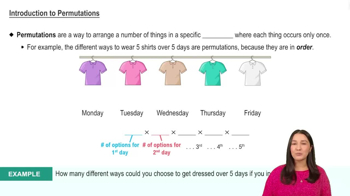
Permutations and Restrictions

Permutations refer to the different ways in which a set of items can be arranged. In this scenario, the restrictions on the first character and the last two characters create specific conditions that must be accounted for when calculating the total number of valid access codes, impacting the overall probability.
Recommended video:
07:11
Introduction to Permutations
Related Practice
Textbook Question

5. Which event(s) in Exercise 4 can be considered unusual? Explain your reasoning.

147
views

Textbook Question

5. Use technology to randomly select two numbers from 1 to 6. Find the sum and subtract 1 to obtain a total.

a. What is the theoretical probability of each total from 1 to 11?

b. Use this procedure to select 100 totals from 1 to 11. Tally your results and compare them with the probabilities in part (a).

101
views
Textbook Question

Finding Conditional Probabilities In Exercises 7 and 8, use the table to find each conditional probability.

7. Business Degrees The table shows the numbers of male and female students in the United States who received bachelor's degrees in business and nonbusiness fields in a recent year. (Source: National Center for Educational Statistics)

a. Find the probability that a randomly selected bachelor's degree-earning student is male, given that the degree is in business.

91
views
Textbook Question

"Using the Multiplication Rule In Exercises 19-32, use the Multiplication Rule.

26. Worst President In a sample of 1500 adult U.S. citizens, 690 said that Donald Trump was the worst president in U.S. history. Three adult U.S. citizens are selected at random.

(Adapted from YouGov)

a. Find the probability that all three adult U.S. citizens say that Donald Trump was the worst president in U.S. history."

47
views
Textbook Question

"1. What is the difference between independent and dependent events?

182
views
Textbook Question

2. How many possible variations are there in Mozart's Musical Dice Game minuet? Explain.

81
views